Asado Catering in Israel: The Cut That Needs Hours, Not Minutes
TL;DR
Asado is the one cut on a BBQ menu that cannot be cooked when the guests arrive. A steak is ready at about 55°C after a few minutes over the coals; a short rib stays tough until its collagen has melted, which takes hours and an internal temperature of around 90 to 95°C. So the real question behind asado catering is not whether a caterer can cook it, it is when they light the fire for it. That decides the format: whole asado belongs on a long daytime event where the fire is the afternoon, while at a standing evening event short rib works as something prepared ahead, like the slow-braised short rib we pull into bao as a starter. On price, Israeli butchers sell asado at around ₪70-80 a kilo against ₪250 and up for entrecôte, but roughly 40% of what you buy is bone and rendered fat, so ₪80 on the label is about ₪133 for each kilo that reaches the plate. On our calculator asado is a standard cut: it never pushes a menu into the ₪315 or ₪340 premium tiers and it does not take one below ₪290 a guest either. All prices include 18% VAT.
What does asado actually mean when you order it in Israel?
Two different things, and most confusion about asado catering starts with mixing them up. At an Israeli butcher, asado is a cut: number 9 in the Israeli numbering system, the short rib from the rib and plate section, fatty, full of connective tissue and sitting on flat bones. In Argentina and Uruguay, asado is an event: a long afternoon, usually Sunday lunch, built around a grill called a parrilla and a person called the asador, with a sequence of cuts, sausages and offal coming off wood embers or charcoal over several hours.
When people in Israel search for asado catering, they usually want a bit of both: the cut, because they have eaten a great one at a restaurant or out of someone's oven, and the feeling of the Argentine afternoon, where the fire is the point of the gathering rather than the thing in the corner producing food.
It is worth being precise with your caterer about the cut, because the word alone does not tell you what arrives. Israeli butchers sell asado bone-in as a slab, boneless, or sliced across the bones into strips, and each of those cooks differently. Thin cross-cut strips are close to the Argentine tira de asado: they cook faster and are eaten with more chew, which is the style. The thick Israeli slab is the hours version. Whatever you agree, the cut, bone-in or boneless, and the butcher should be in writing on the quote.
Why can't asado be cooked to order like a steak?
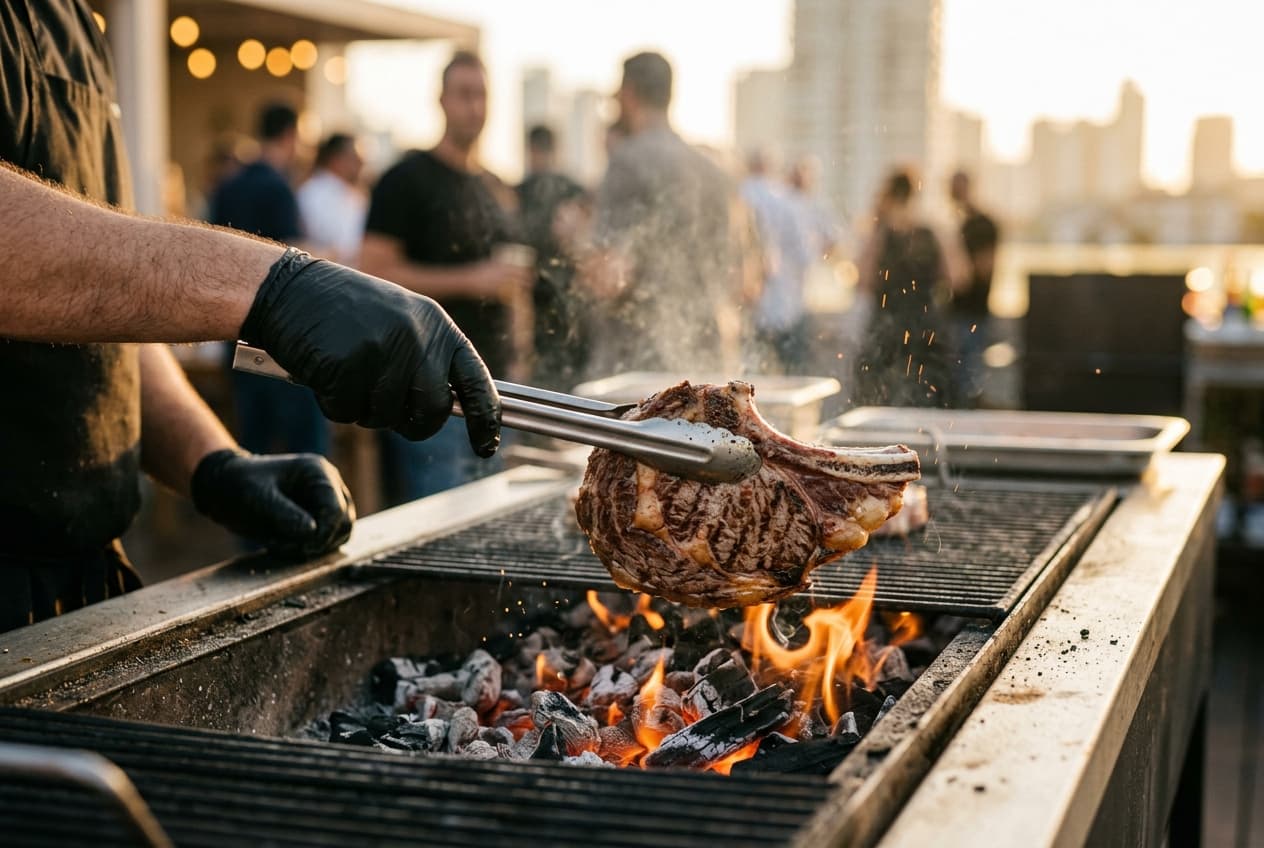
Because a steak and a short rib are finished by completely different things. A steak is finished by temperature: an entrecôte is medium-rare at around 55°C, reached in minutes over hot coals, and it is at its best eaten seconds after it is sliced. That is why a live-fire event runs in waves, with steaks coming off the grate as guests are ready for them.
A short rib is finished by time. Its toughness is collagen, the connective tissue running through the meat, and collagen only turns soft after a long stretch at temperature. A slab of asado is typically ready somewhere around 90 to 95°C internal, and it gets there slowly: three hours at the very least, and a slab cooked low over coals or smoke commonly takes six or more. Cook it hot and fast like a steak and you get a handsome, chewy piece of meat that nobody finishes.
This is also why Israelis mostly know asado from the oven, the smoker and the Friday pot rather than from the mangal. The cut has not changed; the method that suits it is simply a long one. Every good asado you have eaten was started hours before you sat down, whether that meant a low fire lit at dawn or a braise the day before finished over the coals.
| Entrecôte | Asado (short rib slab) | |
|---|---|---|
| What finishes it | Temperature | Time at temperature |
| Ready at (internal) | About 55°C, medium-rare | About 90-95°C |
| Time on the fire | Minutes | Three hours at least, often six or more |
| Cooked to order in waves? | Yes | No. Started before the guests arrive |
| Easy to eat standing? | Yes, sliced | Harder: bone and fat want a plate and a knife |
Is asado actually cheaper than steak?
Per kilo on the shelf, very much so. In September 2026 we found bone-in asado at ₪70 a kilo at Atliz Oriya and ₪80 a kilo at 4 Katzavim, and one published butcher price list puts the range at ₪49-119. Entrecôte at the Gush Dan private butchers we buy from typically sits around ₪290 a kilo. On the label, asado is barely a quarter of the price.
On the plate, the gap closes. Roughly 40% of a bone-in asado is bone and fat that renders away in the cook, where entrecôte loses about 18% to trim and cooking, so the honest comparison is the price of each kilo that actually reaches a guest. At ₪80, asado costs about ₪133 per edible kilo. That is still well under half of entrecôte, but it is almost double kebab or pargit, and it sits closer to picanha than to the grill items.
It also changes how much has to be bought. In our own purchase model, swapping sirloin for asado on a four-item menu for 30 guests grows the raw order by about 2.3 kg for exactly the same amount of food on the board. None of that is a reason not to serve it. It is a reason to choose asado because you want to eat asado, not because it looks like a bargain on a price list.
| Cut | Shelf price | Edible share | Per edible kg |
|---|---|---|---|
| Asado, bone-in | ₪80 | ~60% | ~₪133 |
| Entrecôte | ₪290 | ~82% | ~₪354 |
| Sirloin (sinta) | ₪230 | ~85% | ~₪271 |
| Picanha | ₪155 | ~85% | ~₪182 |
| Kebab | ₪70 | ~92% | ~₪76 |
| Pargit | ₪65 | ~90% | ~₪72 |
Where does asado belong at an event, and where doesn't it?
It depends on the shape of the event far more than on the guest list. Most of what we cook is the standing evening event: guests arrive over forty minutes, starters cover the arrival, and then steaks and grill items come off the fire in waves for a couple of hours. That format is built around cuts that are ready in minutes, and a whole asado slab fits it badly. It cannot be cooked to order, and bone-in short rib is awkward to eat with a drink in the other hand.
Short rib does have a place in that evening, as something whose hours were spent before the first guest arrived. On our starter menu it is the Asian-style short rib: slow-braised with soy, ginger, garlic and sesame, pulled off the bone and stuffed into bao with pickled daikon and scallions. It comes out as fast as people walk in precisely because the slow part is already done.
Whole asado belongs to the other format, the one the Argentines built it for: a long daytime event where people sit, linger and eat over hours, and where the fire has been lit early enough for the short rib to be ready when the table is. If that is the afternoon you have in mind, say so in the first message, because it changes the timing of everything, starting with when the crew arrives.
| Event format | Asado as whole ribs | Short rib prepared ahead |
|---|---|---|
| Standing evening, food in waves | A poor fit | Yes, as a starter |
| Long daytime lunch, seated or lingering | Yes, the classic format | Yes |
| Corporate lunch on a fixed clock | Only if the fire starts early | Yes |
| Small table at home | Ask. It depends on the hours | Yes |
When can a long asado afternoon happen in Israel?
Not on Shabbat. The Argentine asado is a Sunday lunch, and the Israeli instinct is to translate that into Saturday. It does not translate: we do not work a fire from candle-lighting to havdalah, or on any day of Yom Tov, and a cut that needs six hours on the coals makes that line harder to work around, not easier. The long asado afternoon in Israel is a weekday, a Friday that ends well before candle-lighting, or Chol HaMoed.
Fridays shrink with the season. On 16 October 2026 candle-lighting in Tel Aviv is at 17:47, which leaves a workable Friday lunch if the fire is lit early in the morning. Once the clocks go back at the end of October it gets tight: on 20 November candles are at 16:18, and a six-hour cook plus a long lunch plus a clean breakdown no longer fits comfortably in the day.
Chol HaMoed Sukkot is the best asado window of the autumn. In 2026 it runs from Sunday 27 September to Thursday 1 October, ordinary working days with families off work and nowhere to be, which is exactly the Argentine afternoon. Hoshana Raba on Friday 2 October ends at candle-lighting, 18:04, because Shemini Atzeret begins that evening and runs straight into Shabbat. The grill stands outside the sukkah, never inside it, for the same ventilation reason it never goes indoors.
| Date | What it is | For a long asado afternoon |
|---|---|---|
| Sun 27 Sep to Thu 1 Oct 2026 | Chol HaMoed Sukkot | The best window of the season |
| Fri 2 Oct 2026 | Hoshana Raba, candles 18:04 | Only an early lunch, then Shemini Atzeret and Shabbat |
| Fri 16 Oct 2026 | Candles 17:47 | Workable with a very early fire |
| Fri 20 Nov 2026 | Candles 16:18 | Too short for a slab cook |
| Any Sunday to Thursday | Ordinary weekday | Yes |
| Shabbat and Yom Tov | No fire | Never |
Can an Argentine asado be kosher, and what does it cost with us?
The cut itself, yes. Parts of the Argentine spread, no, and it is worth knowing which before you promise anyone a traditional parrillada. Morcilla is blood sausage and has no kosher version. Provoleta, the grilled cheese that often opens an asado, cannot sit on a kosher meat table. The classic chorizo is pork; on our menu merguez does that job. Chimichurri needs no changes at all and is on our sauce list as it is.
Kosher is available on request rather than a standing certification we claim. It means an on-site mashgiach and a kashered grill, arranged per event and quoted as its own line. The meat comes from named butchers: Bat HaKatzav on Brodetzky 43 in Ramat Aviv, Maadanei HaKatzav on Ben Gurion 13 in Herzliya, which carries Rabbanut Herzliya, and for mehadrin requests Atliz Lemhadrin on Tzora 3 in Kfar Shalem, which carries Badatz Machpud, Beit Yosef and Eda HaChareidis. The butcher and certifying body go in writing on the quote, and you can check the shop against the Chief Rabbinate's public kosher business database before paying a deposit.
On price, asado is a standard cut on our calculator, not a premium one. Our events are ₪290 per guest all-inclusive from 20 guests, ₪315 when the menu carries two premium cuts such as entrecôte and picanha, and ₪340 with three or more, with a ₪6,700 event minimum that binds up to about 23 guests. Asado never moves a menu into the higher tiers, and it does not take it below ₪290 either: 30 guests on a four-item menu with asado is ₪8,700, the same as with a second steak. Adding it as a fifth item is where it shows, because every item past four carries its own buying and prep: 30 guests on five items is ₪300 a guest, ₪9,000. Children are billed at 55% of a portion, so 30 adults and 10 children come to ₪10,300. Every figure includes 18% VAT, with no service charge and no tip.
The grill needs open air, so a garden, a courtyard, a roof or an open balcony rather than anything glassed in, and we cover Tel Aviv, Gush Dan and the Sharon without a travel line. Send the date, whether you mean daytime or evening, the number of adults and children, a photo of the space and the kosher standard, and we will tell you plainly whether asado belongs on that menu.
Frequently asked
What is asado in Israel?
At an Israeli butcher, asado is cut number 9: the short rib from the rib and plate section, fatty and full of connective tissue, sold bone-in as a slab, boneless, or cut across the bones into strips. In Argentina the word also means the whole event, a long afternoon around the grill.
How long does asado take to cook?
Hours, not minutes. Short rib is tough until its collagen melts, which happens around 90-95°C internal after a long time at temperature: three hours at the very least, and a slab cooked low over coals or smoke commonly takes six or more. Thin cross-cut strips cook faster but are eaten with more chew.
Can you serve asado at a standing evening event?
As whole ribs cooked to order, not well: it cannot be cooked in waves like steak and bone-in short rib is awkward to eat standing. As something prepared ahead, yes. Our Asian-style short rib is slow-braised, pulled and served in bao as a starter. Whole asado belongs on a long daytime event.
Is asado cheaper than steak for catering?
Cheaper, but less than the label suggests. Bone-in asado was ₪70-80 a kilo at Israeli butchers in September 2026 against about ₪290 for entrecôte, but roughly 40% is bone and rendered fat, so ₪80 on the shelf is about ₪133 per kilo you eat. That is under half of entrecôte and almost double kebab or pargit.
Does choosing asado change the price with RBBQ?
Asado is a standard cut on our calculator. It never pushes a menu into the ₪315 or ₪340 premium tiers and it does not take one below ₪290 a guest: 30 guests on four items with asado is ₪8,700. As a fifth item it adds the cost of one more cut, so 30 guests on five items is ₪9,000. All prices include 18% VAT.
Can an Argentine-style asado be kosher?
The cut, yes, with kosher arranged on request: an on-site mashgiach, a kashered grill and a named butcher in writing. Some of the traditional spread cannot be: morcilla is blood sausage and provoleta is cheese on a meat table. Merguez stands in for chorizo and chimichurri needs no changes.
Can we do an asado lunch on Shabbat?
No. We do not work a fire from candle-lighting to havdalah or on Yom Tov. A long asado afternoon works on any weekday, on Chol HaMoed, or on a Friday that finishes well before candle-lighting, which in Tel Aviv is 17:47 on 16 October 2026 and 16:18 by 20 November.