BBQ Catering Menu: Which Cuts Actually Belong on Your Grill
TL;DR
A BBQ catering menu is built from three decisions, not one. First, plan about 400–450g of raw meat per guest across all proteins — that already accounts for people who barely eat and the friend who does not stop. Second, pick two or three premium cuts as the centrepiece rather than six, because a grill cooking six different steaks to six different temperatures serves everything slightly wrong. Third, know what bone costs you: a tomahawk is roughly 30% bone by weight and short rib closer to 40%, so a kilo ordered is not a kilo eaten. Premium steaks run about ₪200–₪350 per kilo at Israeli private butchers while kebab, merguez and pargit sit at ₪45–₪90, which makes the ratio of steak to grill items by far the biggest lever on the cost of your event. Our own menu runs six cuts — entrecôte, tomahawk, picanha, sirloin, Denver and flat iron — and the balanced version most events land on is two premium steaks, one value cut and two grill items.
Which cuts are actually worth putting on a catering menu?
The honest filter is not which cut is best — it is which cut survives being cooked for a crowd. A restaurant grills one steak for one table and rests it properly. An event grill cooks in waves for thirty to eighty people, sliced onto boards and eaten within minutes. Cuts that need exact timing and a fifteen-minute rest to be worth their price are the wrong instrument for that job, which is why the list below is shorter than most caterers' menus.
Our menu runs six cuts, and they were chosen for that reason. Entrecôte is the default: heavy marbling from the rib section, forgiving on the grill, and it still tastes like something at medium rather than only at medium-rare. Tomahawk is the showstopper — a bone-in ribeye with a long bone that gets carried through the crowd whole before it is sliced, which is half of what you are paying for. Picanha, the Brazilian rump cap, is the one guests remember: the fat cap renders down into the meat over the coals and it slices into strips people take with their fingers. Sirloin, or sinta, is leaner and firmer with a clean beefy taste for guests who find ribeye too rich. Denver is a well-marbled chuck cut that eats far above its price. And flat iron is the value cut that no guest identifies as a value cut — tender, buttery, best served rare to medium-rare.
Two cuts we deliberately leave off the event menu: brisket and asado. Both are excellent and both are long-cook cuts. Brisket loses roughly a third of its weight to trim and cooking, short rib closer to forty percent to bone, and neither can be cooked to order in front of guests in the waves an event runs on. If you want them, they belong at a slow lunch, not at a standing evening event, and any caterer who puts them on a live-fire menu without saying so is selling you the name rather than the food.
One more rule that saves more events than any cut choice: pick two or three premium cuts, not six. A grill running six different steaks to six different target temperatures gets most of them slightly wrong, and guests notice a badly cooked entrecôte far more than they notice a cut that was not on the menu.
| Cut | Character | Recommended temp |
|---|---|---|
| Entrecôte | Rich marbling, bold flavour, from the rib section — the safe default | Medium-rare to medium |
| Tomahawk | Bone-in ribeye showstopper, dramatic long bone, carried whole then sliced | Medium-rare |
| Picanha | Rump cap with a fat cap that renders into the meat — juicy, aromatic | Medium-rare |
| Sirloin (sinta) | Leaner, firm texture, clean beefy taste for guests who find ribeye heavy | Medium-rare |
| Denver | Well-marbled chuck cut, surprisingly tender, deep beefy richness | Medium-rare |
| Flat iron | Tender and buttery — the value cut nobody identifies as one | Rare to medium-rare |
How much meat per guest do you actually need?
Plan roughly 400–450g of raw meat per guest across all proteins. That is the number we build menus on, and it is deliberately generous: it covers the guest who eats one skewer and leaves, the guest who works through four, and the fact that at a standing event people graze across two or three hours rather than eating one plate.
The word doing the work in that sentence is raw. Meat loses weight between the butcher's scale and the board, and the loss is not uniform across cuts — which is exactly where catering menus quietly go wrong. Order 10kg of tomahawk and you are serving about 7kg of meat, because roughly 30% of a tomahawk's weight is that photogenic bone. Order 10kg of entrecôte and about 8.2kg lands on the board. Order short rib and you are down near 6kg. None of that is a problem as long as it was counted; it becomes a problem when the quantity was planned on the invoice weight and the grill runs dry at the ninety-minute mark.
This is also the answer to the most common question we get, which is whether to add a cut or add quantity. If the fear is people going hungry, add quantity to the cuts already on the menu. If the fear is the menu looking thin, add one grill item — skewers, merguez, arayes — not a fourth steak. Variety at a live-fire event comes from the spread on the table, not from the number of steaks the same grill is trying to time at once.
| Cut | Approx. yield | What 10kg ordered serves |
|---|---|---|
| Flat iron | ~88% | ~8.8 kg |
| Picanha / sirloin / Denver | ~85% | ~8.5 kg |
| Entrecôte | ~82% | ~8.2 kg |
| Merguez / kebab / skewers | ~90–95% | ~9.0–9.5 kg |
| Tomahawk (bone-in) | ~70% | ~7.0 kg |
| Asado / short rib (bone-in) | ~60% | ~6.0 kg |
What do these cuts really cost per kilo in Israel?
Worth knowing before you read any quote, because it explains why two catering offers for the same guest count can differ by thousands of shekels without either of them being dishonest. We track per-kilo prices for every cut on our menu from Israeli butcher price lists and comparison listings; the ranges below are what private butchers were charging as of June 2026, alongside supermarket pricing for the same cut.
The pattern in that table is the whole point. Premium steaks run roughly four to five times the price of the grill items per kilo. Entrecôte at a private butcher sits around ₪250–₪336 a kilo and tomahawk reaches ₪350; pargit, kebab, merguez and wings live between ₪28 and ₪90. So the single biggest number in your menu is not which steak you picked — it is what share of the 400–450g per guest is steak at all.
The supermarket column is there for honesty, not as a recommendation. Supermarket and imported frozen meat genuinely is cheaper, sometimes by half, and a caterer quoting a low per-guest price is usually buying there. That is a legitimate business — it is just a different product from a fresh cut bought by name from a butcher, and you are entitled to know which one you are being sold. Ask any caterer, including us, to write the butcher's name onto the quote. We buy from Bat HaKatzav on Brodetzky in Ramat Aviv, a boutique kosher butcher known for dry-aged steaks and tomahawks; Meshek Lagziel in Ramat Gan, a sixty-year-old family business specialising in dry-aged beef, house sausages and their own kebab recipe; Roni Tassa's boutique butchery in Ramat Chen; and Atliz Lemhadrin in Kfar Shalem, which carries Badatz Machpud, Beit Yosef and Eda HaChareidis certification.
| Cut | Private butcher ₪/kg | Supermarket ₪/kg |
|---|---|---|
| Tomahawk | 200–350 | 150–230 |
| Entrecôte | 250–336 | 120–180 |
| Sirloin (sinta) | 200–238 | 90–150 |
| Denver | 150–200 | 80–140 |
| Picanha | 120–190 | 110–150 |
| Flat iron | 120–180 | 80–140 |
| Mixed skewers | 80–160 | 60–120 |
| Kebab | 55–90 | 45–80 |
| Pargit (chicken thigh) | 45–85 | 35–55 |
| Merguez | 55–80 | 45–70 |
| Chicken wings | 28–50 | 20–40 |
How do you mix premium cuts and grill items?
Three mixes cover almost every event we cook, and choosing between them is a real decision rather than a menu preference. A balanced menu — two premium steaks, one value cut like Denver or flat iron, and two grill items such as skewers and merguez — is where most events land and what we recommend by default. It gives the grill a workable rhythm, gives guests variety on the board, and keeps the steak share at a level where the premium cuts still feel like an event rather than a buffet line.
A premium-led menu pushes the steak share up: three premium cuts, tomahawk included, with grill items as support rather than volume. It is the right call for a milestone — a fiftieth birthday, a chag dinner, a client-facing corporate evening — and it is genuinely more expensive because the meat itself is more expensive, not because a line item was added. A grill-led menu inverts it: one premium cut sliced onto boards as the centrepiece, with kebab, pargit, merguez and arayes carrying the volume. That is not a downgrade for every event. For a bar mitzvah where half the room is thirteen years old, or a hundred-person company barbecue, it is frequently the better menu regardless of budget, because teenagers and a lunchtime crowd eat skewers, not dry-aged sirloin.
With us the mix moves the per-guest price, and the calculator on our homepage shows that movement as you tick cuts on and off rather than burying it in a revised quote a week later. The reason to be explicit about this: menu mix is the one budget lever that does not cost you guests. Adding names to the list costs ₪290 each. Moving one premium cut to one value cut costs nobody an invitation.
| Mix | What's on the grill | Best for |
|---|---|---|
| Balanced (our default) | 2 premium steaks + 1 value cut + 2 grill items | Most events — 20–60 guests, mixed crowd |
| Premium-led | 3 premium cuts incl. tomahawk, grill items as support | Milestones, chag dinners, client-facing evenings |
| Grill-led | 1 premium cut sliced on boards + kebab, pargit, merguez, arayes | Bar/bat mitzvahs, kids, large company barbecues |
Does the event type change which cuts you should order?
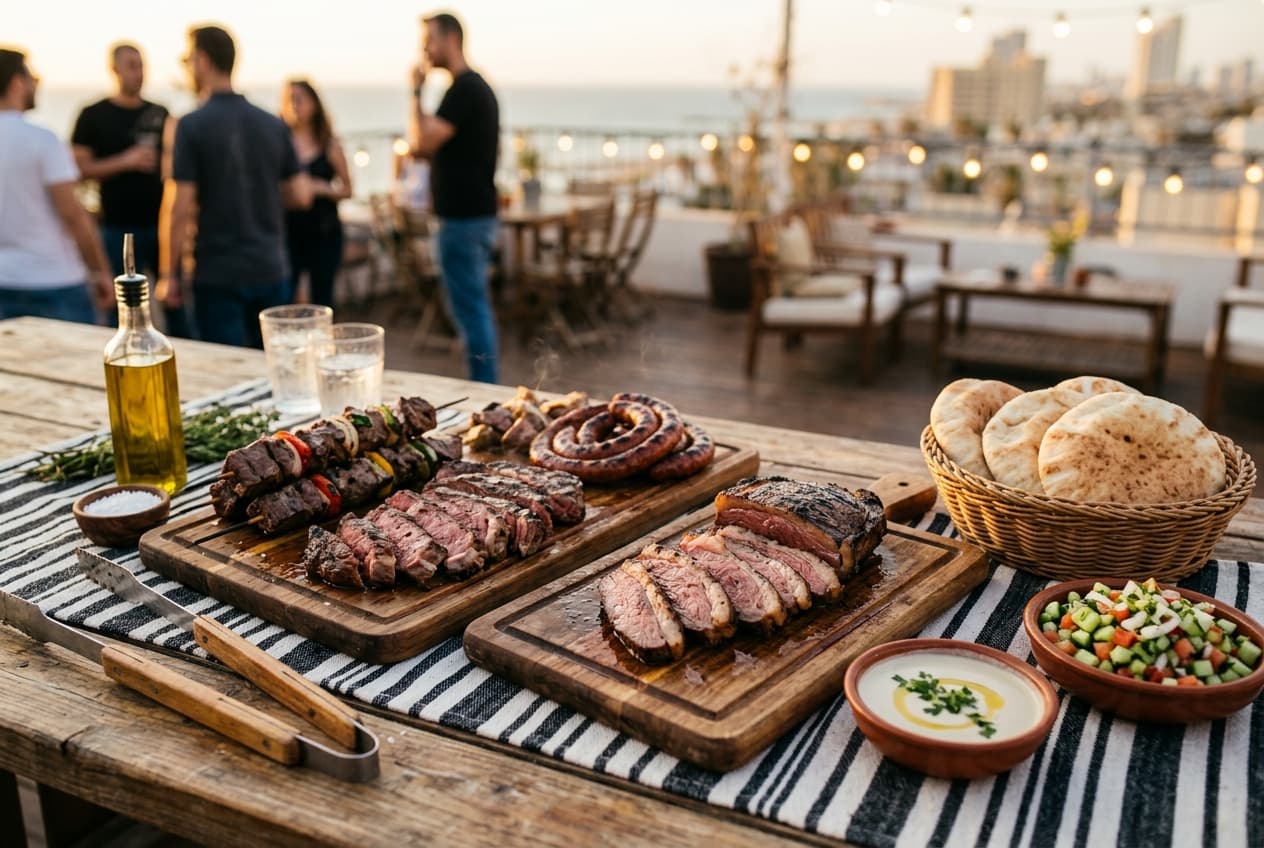
More than the budget does. A standing event — engagement party, corporate evening, rooftop birthday — puts one constraint on the menu that overrides taste: a guest holding a drink has exactly one free hand. Steaks get grilled whole for the crust and then sliced across the grain onto wooden boards into strips you can take with your fingers or a small fork. Picanha and flat iron are excellent this way. A bone-in tomahawk is not a standing-event food until it has been carved, which is precisely why it gets carried through the crowd whole first and then broken down at the board.
A seated family meal — a chag dinner, a Friday lunch, a brit seudah — flips it. There the plate is stable, so richer cuts and heavier temperatures work, and the tomahawk earns its place at the centre of a table rather than in a passing hand. Kids' events want the opposite of everything above: skewers, pargit, kebab and merguez, food on a stick or in a pita, cooked through and not pink. And a corporate lunch on a fixed clock wants cuts that come off the grill fast and forgiving, because forty engineers with a meeting at two will eat whatever is ready at 12:40 and ignore whatever is still resting.
One planning note that applies to all of them: count the vegetarians, the children and the allergies before the menu is built, not at the grill. Grilled vegetables, the fire-roasted eggplant with tahini and pomegranate, and simpler proteins for kids are planned in from the start. Improvising them mid-service is how a grill falls forty minutes behind.
What about the half of the menu that isn't steak?
It matters more than most hosts expect, because it is what guests eat during the forty-minute arrival curve before the first cuts come off the grate. Our starters run beef carpaccio bruschetta, merguez with dijon and harissa, mini arayes with tahina and pomegranate molasses, Asian-style short ribs pulled into bao sliders, and fire-roasted eggplant with tahini, pomegranate and za'atar. Those are on the table before the steak exists, and they are the reason nobody is standing at the grill asking how long.
Sides are built to survive an outdoor table rather than to look good for four minutes: charred gem lettuce with herbs and toasted almonds, roasted beet carpaccio with pickled onion and dill, confit baby potatoes finished crisp in a cast-iron pan, silan-glazed carrots with dukkah, and twice-cooked fries. Sauces are not a separate course — every cut comes with the house set: chimichurri, red wine and bone marrow jus, garlic confit, sriracha aioli, chipotle aioli, tehina and amba.
Desserts at a meat event are pareve by definition, which is a constraint worth planning around rather than apologising for. Ours are sorbet, fruit skewers with a warm pareve dark-chocolate sauce, a berry tart on a coconut-cream base and individual chocolate lava cups. If a caterer offers you a cream-based dessert after a kosher meat meal, that is a sourcing question you want to ask before the event and not after.
Does keeping kosher change the menu?
It changes the sourcing, the finishing and the dessert — not the cut list. All six cuts on our menu are available kosher, and every one of them is bought from the butchers named above rather than from a wholesaler we describe with adjectives. What kosher does rule out is the dairy end of grill technique: no butter-basting the steak, no cream sauces, no cheese in the salads. Everything above is built that way already, which is why the sauce set is oil-, egg- and tahini-based.
There is one real trap in kosher meat catering, and it is not the meat — it is the vagueness. 'Kosher' on its own is not a specification. Ask which butcher, ask which certification, and ask for both in writing on the quote, then check the name yourself against the Chief Rabbinate's public kosher databases. For families holding a stricter standard, our answer is Atliz Lemhadrin in Kfar Shalem, which carries Badatz Machpud, Beit Yosef and Eda HaChareidis certification, plus an on-site mashgiach and a dedicated kashered grill arranged per event, on request. Arranged for your specific date is the honest description of that — it is not a standing kitchen certificate, and we would rather say so than let you assume otherwise.
Salting and koshering also mean kosher beef behaves slightly differently on the grill: it is already seasoned by the process, so it needs less salt and it browns fast. That is a cooking adjustment, not a compromise, and it is one of the reasons a crew that cooks kosher meat every week gets a better crust out of it than a home grill does.
So what does the menu do to the price?
The event format is ₪290 per guest, all-inclusive, from 20 guests, with a ₪6,700 event minimum that covers up to about 23 people. All-inclusive means the quote is the invoice: the cuts, the starters, salads, breads and sauces, soft drinks, the grill and coals, the crew, live cooking through the event, service and full cleanup. So a 30-guest event is ₪8,700, 50 is ₪14,500 and 80 is ₪23,200. Below 20 guests the right format is the private chef instead — ₪1,900 for two, ₪2,700 for four, ₪3,500 for six — same fire, same butchers, sized for one table.
Within that, the menu mix is what moves the number, and you can move it yourself in the calculator on our homepage before talking to anyone. The practical version of everything above: start from the balanced mix, add a premium cut only if the event is a milestone, and if the total is uncomfortable, shorten the guest list before you downgrade the meat. Guests notice the meat.
To get a quote, send one message with the date, a rough guest count, the address, and a photo of the garden, roof or balcony where the grill would stand. The butcher's name goes on the quote. If you would rather talk through the menu than pick it yourself, say so in the same message — building the menu with the host is the part of this job we actually enjoy.
| Guests | Price | How it's calculated |
|---|---|---|
| 2–6 (one table) | ₪1,900–₪3,500 | Private-chef format, published ladder |
| 20–23 | ₪6,700 | Event minimum applies |
| 30 | ₪8,700 | 30 × ₪290 |
| 50 | ₪14,500 | 50 × ₪290 |
| 80 | ₪23,200 | 80 × ₪290 |
Frequently asked
How much meat should I order per guest for a BBQ event?
Plan about 400–450g of raw meat per guest across all proteins. That figure is deliberately generous because it covers light eaters, heavy eaters, and the fact that guests graze across a standing event rather than eating one plate. Remember it is raw weight: bone-in cuts lose a lot on the way to the board — a tomahawk is roughly 30% bone and short rib closer to 40%, while entrecôte yields about 82% and skewers or merguez around 90–95%.
Which cuts are best for a catered BBQ in Israel?
For a live-fire event the six that hold up best are entrecôte, tomahawk, picanha, sirloin (sinta), Denver and flat iron. Entrecôte is the forgiving default, tomahawk is the showstopper, picanha slices into strips people can eat standing, sirloin suits guests who find ribeye too rich, and Denver and flat iron eat well above their price. Brisket and asado are excellent cuts but they are long-cook items that cannot be cooked to order in waves in front of guests, so they do not belong on a live-fire event menu.
How many different cuts should be on the menu?
Two or three premium cuts, not six. One grill cooking six steaks to six different target temperatures gets most of them slightly wrong, and guests notice a badly cooked steak far more than a cut that was absent. If the menu looks thin, add a grill item — skewers, merguez, arayes — rather than a fourth steak. The mix most events land on is two premium steaks, one value cut and two grill items.
How much does the meat itself cost per kilo in Israel?
As tracked in June 2026, premium steaks at Israeli private butchers run roughly ₪250–₪336 per kilo for entrecôte, ₪200–₪350 for tomahawk, ₪200–₪238 for sirloin and ₪120–₪190 for picanha, while grill items sit far lower — kebab ₪55–₪90, merguez ₪55–₪80, pargit ₪45–₪85 and wings ₪28–₪50. Supermarket and imported frozen meat is cheaper, often by half, which is why the share of steak in the menu is the biggest single lever on the cost of an event.
Are all the cuts available kosher?
Yes. All six cuts on our menu are bought kosher from butchers named on the quote: Bat HaKatzav in Ramat Aviv, Meshek Lagziel in Ramat Gan, Roni Tassa's boutique butchery in Ramat Chen, and Atliz Lemhadrin in Kfar Shalem, which carries Badatz Machpud, Beit Yosef and Eda HaChareidis certification. Keeping kosher rules out dairy in grill technique — no butter-basting, no cream sauces, no cheese in the salads, and pareve desserts — but it does not change the cut list. An on-site mashgiach and a dedicated kashered grill can be arranged per event, on request.
How do I lower the cost without ruining the menu?
Move one premium cut to a value cut such as Denver or flat iron, and let grill items carry more of the volume — that lowers the per-guest price without removing anyone from the invitation list, and you can see the effect live in the calculator on our homepage. If the total is still uncomfortable, shorten the guest list before downgrading the meat: at ₪290 per guest, cutting ten names saves ₪2,900, and it is the change your guests are least likely to notice.