BBQ Catering in Petah Tikva, Rishon LeZion and Netanya
TL;DR
RBBQ cooks on-site across Gush Dan and up the coast, which includes Petah Tikva, Rishon LeZion and Netanya — roughly 25 to 45 minutes from Tel Aviv off-peak. The price is exactly the same as a Tel Aviv event: ₪290 per guest all-inclusive (rising to ₪315 or ₪340 if you load two or three premium cuts), with a ₪6,700 minimum that covers up to about 23 guests. There is no travel line, no distance band and no out-of-city surcharge, because the calculator on our homepage has no field for your address. What genuinely changes outside Tel Aviv is the venue: private gardens and single-family yards instead of shared rooftops, which means more space for the grill and the boards, easier unloading, and a different set of things to check — gate width, a flat non-flammable spot for the fire, and where the crew parks a loaded vehicle for ninety minutes before guests arrive.
Do you actually cover Petah Tikva, Rishon LeZion and Netanya?
Yes. The service area is Tel Aviv and the wider Gush Dan, extending up the coast through the Sharon. Petah Tikva and Rishon LeZion sit inside Gush Dan proper and are roughly a 25 to 35 minute drive from central Tel Aviv outside rush hour. Netanya is further — call it 40 to 45 minutes up Route 2 — and it is still a normal booking rather than a special case. Past events have run in Herzliya, Hod HaSharon, Ramat HaSharon and across the Sharon, so the crew is not new to loading a grill into a vehicle and driving it somewhere.
The reason distance matters less than people assume is that nothing on the menu is cooked before the drive. A traditional caterer's logistics problem is keeping cooked food hot and safe between their kitchen and your address, and that problem does get worse with every kilometre. Our logistics problem is completely different: the meat, the grill, the coals, the boards and the crew arrive raw and cold, and everything is cooked in front of you at your address. A 45-minute drive with raw meat in a cooler is a non-event. A 45-minute drive with cooked entrecôte in a foil tray is the difference between a steak and a stew.
What we need from the address itself is modest and the same everywhere: an outdoor or genuinely well-ventilated space where a charcoal grill can stand, and about ninety minutes before guests arrive. Gardens, yards, moshav plots, building shared gardens, roof decks and wide terraces all work. Send the address on WhatsApp with a photo of the space and we will confirm the setup in that conversation rather than at a site visit three weeks later.
Does the price change outside Tel Aviv?
No, and this is checkable rather than a promise. The pricing model is guest count and menu mix. That is the whole model. There is no distance band, no travel fee, no fuel line and no out-of-city surcharge, and the easiest way to verify it is to open the calculator on our homepage and look for a field asking where you live. There isn't one, because the number does not depend on it.
The base is ₪290 per guest, all-inclusive, from 20 guests, with a ₪6,700 event minimum that covers up to about 23 people. All-inclusive means the quote is the invoice: the cuts, the starters, salads, breads and sauces, soft drinks, the grill and the coals, the crew — roughly one person per 15 to 20 guests — live cooking through the event, service and full cleanup. Loading the menu with premium cuts is the one thing that moves the per-guest number: two premium cuts takes it to ₪315 and three or more to ₪340. So a 40-guest garden event in Rishon LeZion on the standard menu is ₪11,600, and the identical event on a rooftop in Tel Aviv is also ₪11,600.
Below 20 guests the right format is not a shrunken event, it is the private chef: ₪1,900 for two, ₪2,700 for four, ₪3,500 for six. Same fire, same butchers, sized for one table — and that also travels to Petah Tikva, Rishon or Netanya at the published price. A 50% deposit holds the date in all of these formats.
One honest caveat about booking from outside Tel Aviv: what is genuinely scarcer is the calendar, not the kilometres. Friday afternoons, chag eves and the week before Rosh Hashana or Hanukkah fill first regardless of city, and a Netanya Friday and a Tel Aviv Friday are competing for the same crew on the same evening.
| Guests | Standard menu | With 3+ premium cuts |
|---|---|---|
| 2–6 (one table) | ₪1,900–₪3,500 | Private-chef format |
| 20–23 | ₪6,700 | ₪6,700 (minimum binds) |
| 30 | ₪8,700 | ₪9,000 |
| 40 | ₪11,600 | ₪12,000 |
| 60 | ₪17,400 | ₪18,000 |
| 80 | ₪23,200 | ₪24,000 |
What does a garden event outside Tel Aviv change about the setup?
It mostly makes it easier, which is the part hosts do not expect. Central Tel Aviv events are constrained by the building: a shared roof with a locked door and a committee, a service elevator that has to be booked, a balcony where the grill has one legal position, and a street where a loaded vehicle cannot stop for more than four minutes without becoming a municipal problem. Petah Tikva, Rishon LeZion and Netanya are dominated by private gardens, single-family yards and building gardens where none of those constraints exist. The crew unloads next to the gate, walks fifteen metres and sets up. That alone removes the two most common sources of delay on a Tel Aviv event.
The space also changes the shape of the event. A garden lets the grill and the carving boards sit apart from each other rather than stacked into one corner, which means guests can watch the fire without standing in the working area, and the boards can be laid where people already are. On a small rooftop everything is within two metres of everything else and the crew works around the guests. In a garden the crew works next to them. It is the same food and it feels like a different event.
The things worth checking before the day are correspondingly physical rather than bureaucratic. Gate and side-path width, because a grill and gas-free equipment come in on wheels. A flat spot for the fire that is not directly under a pergola roof, low branches, a shade sail or laundry lines. Somewhere to park a loaded vehicle nearby for the setup window. Outdoor lighting if the event runs past dark, because a garden goes properly dark in a way a lit rooftop does not. And access to water and a tap, which makes cleanup faster and better. None of these are dealbreakers — they are things to answer in the first WhatsApp message rather than discover at 17:30 on the day.
| Venue | Common in | Check before the day |
|---|---|---|
| Private garden / house yard | Petah Tikva, Rishon LeZion, Netanya suburbs | Gate width, flat non-flammable spot, overhead clearance, outdoor lighting |
| Building shared garden | New residential blocks in all three cities | House-committee approval, access route from parking, end-time noise rules |
| Wide balcony / terrace | Netanya seafront and tower apartments | Ventilation, clearance from the ceiling above, neighbour notice |
| Roof deck | Central Tel Aviv, newer Rishon towers | Service elevator booking, roof access key, where the vehicle stops |
| Moshav plot / large yard | Sharon periphery | Drive-in access, lighting, distance from the grill to the tables |
Which kosher butchers are in Petah Tikva, Rishon LeZion and Netanya?
Worth separating two questions that usually get merged: which butchers exist near you, and which butcher your caterer actually buys from. They are not the same question and only the second one affects your event.
We buy from four butchers, by name, and they go onto the quote in writing: Bat HaKatzav on Brodetzky in Ramat Aviv, a boutique kosher butcher known for dry-aged steaks and tomahawks; Meshek Lagziel in Ramat Gan, a sixty-year-old family business specialising in dry-aged beef and house sausages; Roni Tassa's boutique butchery in Ramat Chen; and Atliz Lemhadrin in Kfar Shalem, which carries Badatz Machpud, Beit Yosef and Eda HaChareidis certification. That list does not change because your event is in Netanya. The meat is bought in Tel Aviv and Ramat Gan and travels raw and cold in the same vehicle as the grill, which is exactly how it would travel to an event in Tel Aviv.
For the other question — what is actually in your city — our own prospect file tracks certified kosher butchers across the region, and each entry carries the source we verified the kosher claim from rather than an assumption. In Petah Tikva there is Atliz Yossle, which trades on Glatt Kosher Lemehadrin certification. In Netanya there are Papi HaKatzav on Natan Yonatan and Netach Katzavim on HaMehkar 3, both listed as kosher-certified butcher shops on their Easy.co.il business pages. For Rishon LeZion we have no verified entry in our file, and rather than name a shop we have not checked, we would rather say that plainly — the honest answer to 'which kosher butcher in Rishon' is that we do not know yet.
If you are comparing caterers in any of these cities, the useful move is to make each one name their butcher and its certification in writing, then check the name yourself against the Chief Rabbinate's public kosher database. 'Kosher meat' with no butcher and no certification named is not a specification. Any caterer who cannot answer in one sentence is telling you something.
| City | Butcher | How the kosher claim was verified |
|---|---|---|
| Petah Tikva | Atliz Yossle | Trades on Glatt Kosher Lemehadrin certification |
| Netanya | Papi HaKatzav, Natan Yonatan | Easy.co.il business page tagged 'Butcher Shop • Kosher Certificate' |
| Netanya | Netach Katzavim, HaMehkar 3 | Easy.co.il business page tagged 'Butcher Shop • Kosher Certificate' |
| Rishon LeZion | No verified entry in our file | We have not checked one — we will not name a shop we have not verified |
| Our suppliers | Bat HaKatzav · Meshek Lagziel · Roni Tassa · Atliz Lemhadrin | Named in writing on every quote, regardless of event city |
How does the evening actually run at a suburban address?
The crew arrives about ninety minutes before the stated start. In that window the grill is assembled and lit, the coals come up to temperature, the tables are dressed, the starters are plated and the meat is broken down and seasoned. Charcoal is not a gas burner you turn on — it takes real time to reach an even working heat, and a crew that arrives thirty minutes early is a crew that will be serving your first steak at nine.
Guests arrive into food that already exists. The starters are on the table before the first steak comes off the grate, which covers the forty-minute arrival curve that every event has and no host plans for: beef carpaccio bruschetta, merguez with dijon and harissa, mini arayes, fire-roasted eggplant with tahini and pomegranate. That is the single biggest reason nobody stands at the grill asking how long.
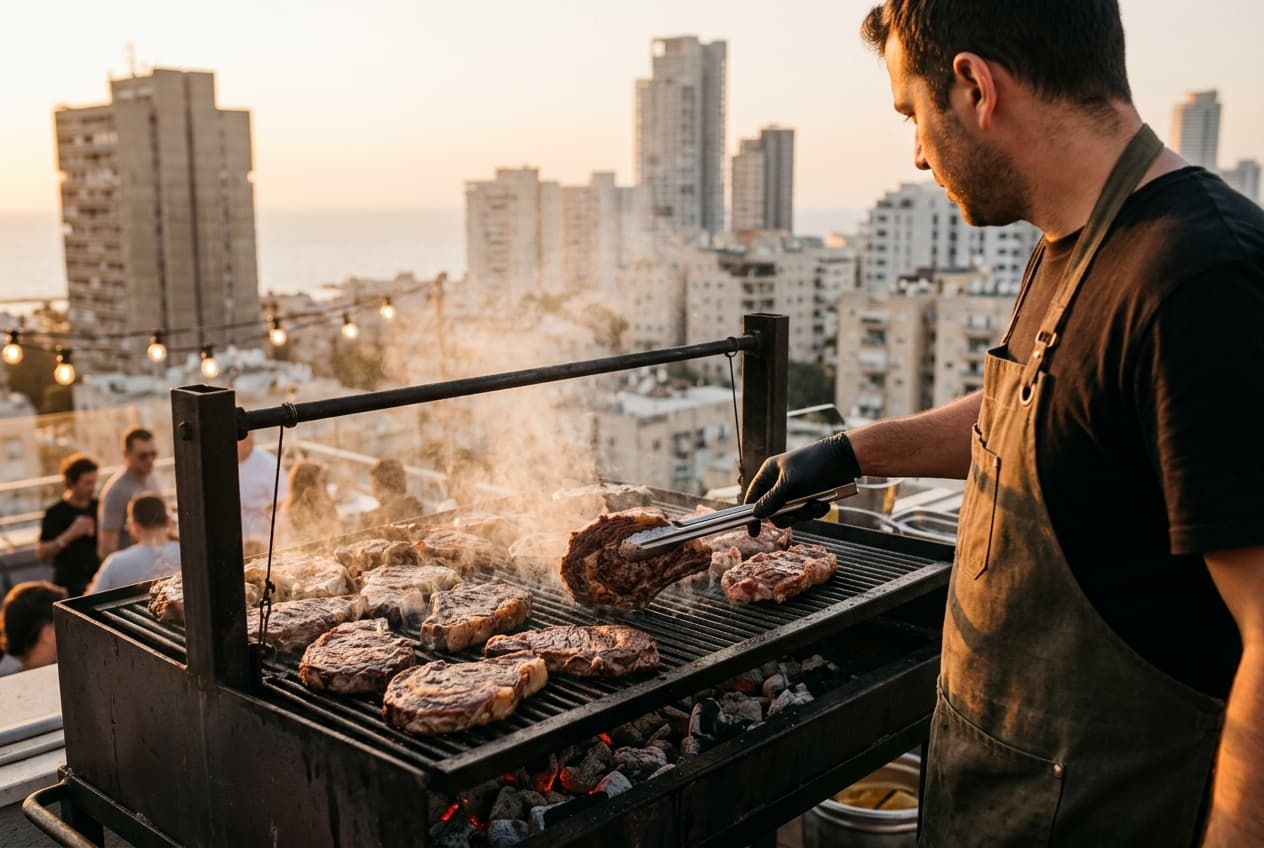
Then the cooking runs in waves through the event rather than as one service. Cuts come off, get sliced across the grain onto wooden boards and go straight to where people are standing, then the next wave goes on. In a garden this works better than on a rooftop simply because there is somewhere for the boards to land. At the end the crew breaks down the grill, bags the coals and takes them away, and cleans the space — which for a private garden means it is left as it was found, not left tidy-ish with a black ring on the tiles.
One planning note that matters more outside Tel Aviv than in it: end times. A residential garden in Petah Tikva or Rishon has neighbours who are five metres away rather than three floors down, and municipal quiet hours are real. Tell us the hard end time in the first message and the timeline gets built backwards from it, rather than the fire still going when it should be out.
Which events suit these cities best?
The venue drives this more than the city does. Gardens and yards favour events where people move around and where children are present, which in practice means family celebrations: a bar or bat mitzvah where half the room is thirteen, a brit seudah, a milestone birthday, a Friday lunch that runs into the afternoon, an engagement party for the two families. Those are the events that get worse in a small apartment and better in a garden, and they are the reason a suburban address is often the right venue even when the hosts live in Tel Aviv.
Corporate events work in these cities for a different reason: office and industrial parks in Petah Tikva, Rishon LeZion and Netanya frequently have a courtyard, a ground-level terrace or an open parking level, which is a better grill position than most Tel Aviv towers can offer. If the office genuinely has no outdoor spot, the format runs at a rented garden venue instead without changing the price.
The menu should follow the crowd rather than the postcode. A mixed family event with children lands best on the grill-led mix: one premium cut sliced onto boards as the centrepiece, with kebab, pargit, merguez and arayes carrying the volume, because teenagers eat skewers, not dry-aged sirloin. A milestone or a client-facing evening justifies the premium-led mix with three cuts including the tomahawk. Most events land in between, on two premium steaks, one value cut and two grill items — and you can move between those three on the calculator and watch the number change before speaking to anyone.
How do you book, and what goes in the first message?
One WhatsApp message with four things: the date, a rough guest count, the address, and a photo of the garden, yard, terrace or roof where the grill would stand. The photo does more work than any description — it answers the surface, the overhead clearance, the access and the size in one glance, and it is why most setups get confirmed in the same conversation rather than after a site visit.
What comes back is a fixed quote naming the butcher and the certification, with the all-inclusive number for your guest count. A 50% deposit holds the date. If you would rather build the menu together than pick it off a list, say so in the same message — that part of the job is the part we actually enjoy.
And if the date is Rosh Hashana week, a chag eve or a Friday in season, send it early even if the guest count is still a guess. A guest count can be adjusted up to a few days before the event. A Friday in September cannot be conjured once it is taken.
Frequently asked
Do you do BBQ catering in Petah Tikva, Rishon LeZion and Netanya?
Yes. RBBQ cooks on-site across Tel Aviv and the wider Gush Dan and up the coast through the Sharon, which includes Petah Tikva and Rishon LeZion (roughly 25–35 minutes from central Tel Aviv off-peak) and Netanya (roughly 40–45 minutes). Nothing is pre-cooked before the drive — the meat, grill, coals and crew arrive raw and cold and everything is cooked at your address, so distance affects the schedule rather than the food.
Is there a travel fee or surcharge outside Tel Aviv?
No. The price depends on guest count and menu mix only — there is no distance band, travel line or out-of-city surcharge, and the calculator on our homepage has no field for your address. A 40-guest event on the standard menu is ₪11,600 whether it is in a Rishon LeZion garden or on a Tel Aviv rooftop.
How much does BBQ catering cost in Petah Tikva or Netanya?
₪290 per guest all-inclusive from 20 guests, rising to ₪315 with two premium cuts and ₪340 with three or more, with a ₪6,700 event minimum covering up to about 23 guests. All-inclusive means meat, starters, salads, breads and sauces, soft drinks, the grill and coals, the crew, live cooking, service and full cleanup — no setup, staffing or cleanup lines added later. Below 20 guests the private-chef format runs from ₪1,900 for two.
What does my garden need for an on-site BBQ?
An outdoor or well-ventilated spot where a charcoal grill can stand on a flat, non-flammable surface with clear space overhead — not directly under a pergola roof, low branches, a shade sail or laundry lines. Beyond that: a gate or path wide enough to wheel equipment through, somewhere to park a loaded vehicle nearby during the 90-minute setup window, outdoor lighting if the event runs past dark, and access to a tap. Send a photo of the space with your first message and we will confirm it there.
Where does the meat come from if the event is outside Tel Aviv?
From the same four butchers, named in writing on your quote: Bat HaKatzav in Ramat Aviv, Meshek Lagziel in Ramat Gan, Roni Tassa's boutique butchery in Ramat Chen, and Atliz Lemhadrin in Kfar Shalem, which carries Badatz Machpud, Beit Yosef and Eda HaChareidis certification. The meat is bought in Tel Aviv and Ramat Gan and travels raw and cold in the same vehicle as the grill.
Are there kosher butchers in these cities?
Yes in Petah Tikva and Netanya, per the verified entries in our prospect file: Atliz Yossle in Petah Tikva trades on Glatt Kosher Lemehadrin certification, and in Netanya both Papi HaKatzav on Natan Yonatan and Netach Katzavim on HaMehkar 3 are listed as kosher-certified butcher shops on their Easy.co.il business pages. For Rishon LeZion we have no verified entry, so we will not name one. Whichever caterer you use, ask them to put the butcher name and certification in writing and check it against the Chief Rabbinate's public kosher database.
How far in advance should I book?
As early as you can for Fridays, chag eves and the weeks before Rosh Hashana and Hanukkah — those fill first and a Netanya Friday competes for the same crew as a Tel Aviv Friday. A 50% deposit holds the date, and the guest count can still be adjusted up to a few days before the event, so send the date before the list is final.