
Brit Milah Catering: The Seudah, Cooked on Live Fire
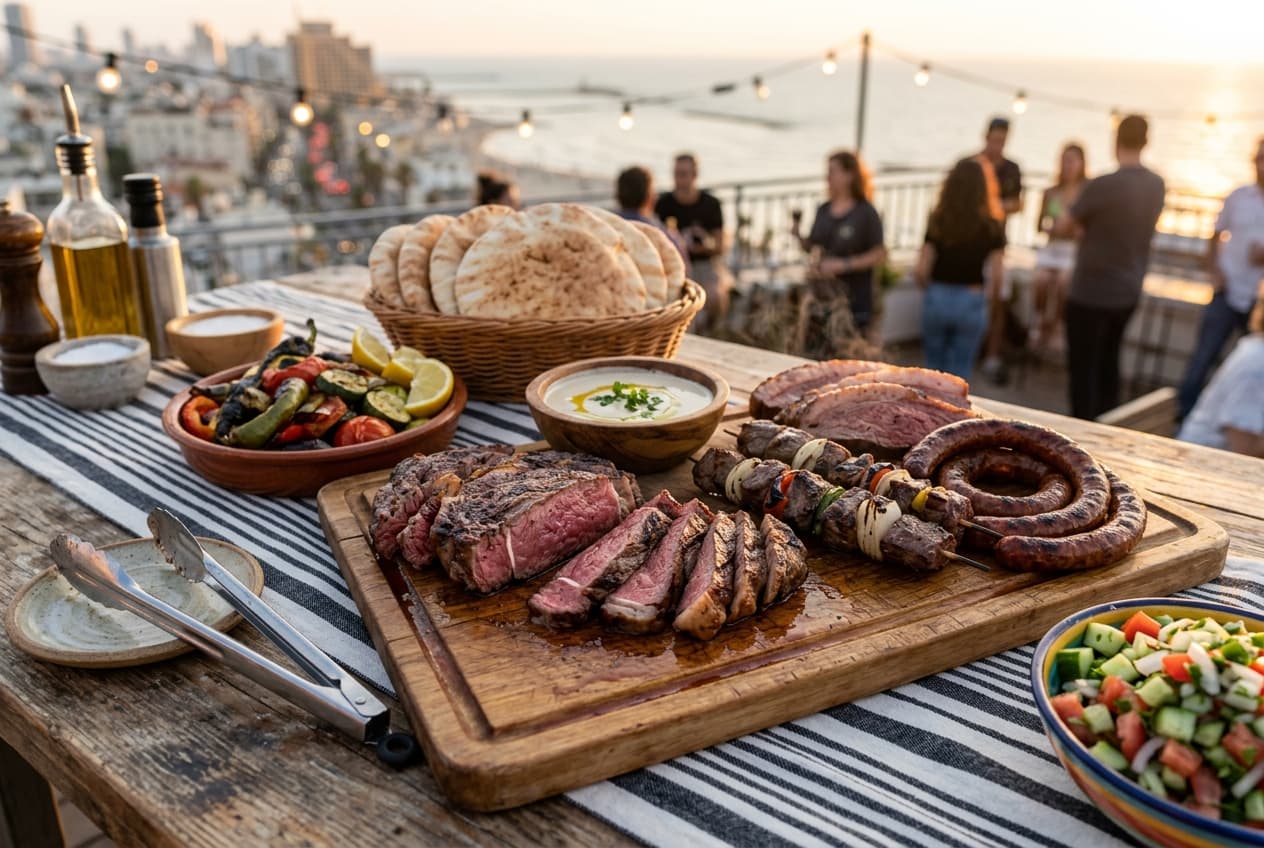
TL;DR
A brit milah is held on the eighth day after birth, counting the birth day as the first — which means you cannot book a date, only a window. The workable approach is to flag the expected week with a caterer while you are still waiting, then confirm the exact date within hours of the birth. On-site BBQ suits the seudat mitzvah well because it runs outdoors on a home or garden space with no venue booking to lock in, and the crew sets up in about 90 minutes. Hold the brit itself early in the day as the custom prefers, and put the live-fire meal at midday or in the evening — a charcoal grill at 8am serves nobody. If the eighth day lands on Shabbat or a chag, the brit still takes place but no crew can cook; families move the seudah to Saturday night or a weekday. Cost is ₪290 per guest all-inclusive from 20 people, with a ₪6,700 minimum covering up to about 23, and premium cuts bought by name from butchers written onto the quote.
Why is a brit the hardest event to book?
Because it is the one celebration where the date is set by someone who has not consulted anybody. A brit milah takes place on the eighth day after birth, counting the day of birth itself as day one, and it is postponed only when the mohel or the doctor says the baby is not ready. So you cannot do what you would do for a bar mitzvah or a wedding — pick a Thursday in November and build outward. You get, at best, a rough due-date window, and then a phone call.
The practical way through this is to split the booking in two. While you are still waiting, tell the caterer the expected week and a rough guest count, so your name sits on the calendar as a soft hold rather than as a stranger calling on a Tuesday morning. Then, once the baby is born and the eighth day is fixed, confirm the exact date and the final headcount. The soft hold is not a guarantee — nobody can promise a crew for a date that does not exist yet, and any caterer who does is not counting the same calendar you are. What it does buy you is a caterer who already knows your event and can answer in minutes instead of asking you to start from the beginning during the busiest week of your life.
Two details make that call go faster. Know the space before the birth — garden, roof, courtyard or balcony — and send a photo of it with the first message, because that is the one thing that can rule a live-fire event out, and you would rather find out in month eight than on day two. And decide roughly how many people you are inviting. A brit is usually a larger crowd than the parents expect: both sets of grandparents, the siblings' families, the neighbours who watched the pregnancy happen. The number that comes out of the first honest count is rarely the number you had in your head.
| When | What you do | What it gets you |
|---|---|---|
| Weeks before the due date | Flag the expected week, rough guest count, photo of the space | A soft hold and a checked, workable venue |
| Day of birth | Confirm the eighth day and the final headcount | The date locked and a fixed quote |
| Day 8 | Brit in the morning, seudah at midday or evening | Crew arrives ~90 minutes ahead of the meal |
Morning ceremony, midday fire — when should the meal actually happen?
The brit itself belongs to the daytime, and the long-standing custom is to hold it early — zrizin makdimin l'mitzvot, you do not let a mitzvah wait. In practice that puts most britot somewhere between eight and ten in the morning, often straight after shacharit at the family's shul. That is the ceremony, and it takes minutes.
The seudat mitzvah is a separate question, and this is where couples over-compress the day. A charcoal grill at 8:15am is the wrong instrument: guests have not eaten, nobody wants ribeye before coffee, and the crew would be lighting coals in the dark. The version that works is the one most Israeli families land on anyway — the ceremony in the morning with something light beside it, and the real meal held later the same day, either as a midday lunch once everyone has come back from work and school runs, or as an evening gathering when the light drops and the fire actually reads as a fire. Same day, same mitzvah, a meal people are hungry for.
If you want the whole thing in one block, a late-morning brit running into a midday seudah works fine — the crew starts setting up while the ceremony is happening, and food comes off the grate from around noon. What does not work is asking a live-fire crew to serve a full meat meal at breakfast hour. We would rather tell you that than take the booking and hand you a lukewarm event.
One more scheduling reality: the eighth day lands where it lands, and roughly one week in seven that is Shabbat. A brit is performed on Shabbat when the eighth day falls there — but no live-fire crew can work, and no caterer can deliver a hot meal. Families generally handle it one of two ways: a kiddush after the ceremony prepared in advance, with the celebratory meal moved to Saturday night once Shabbat is out, or a weekday seudah in the days that follow. The same applies to a chag. Tell us the eighth day even if it is a Shabbat, and we will build around it rather than pretending it is a Tuesday.
Can it run at home, or do you need a hall?
Home is the normal case, and it is the reason on-site catering suits a brit better than a venue does. There is no hall to book months out, no minimum spend attached to a room you have not seen, and no deposit riding on a date that does not exist yet. The event happens where the family already is — a garden in Ramat Gan, a courtyard in Ramat Aviv, a wide balcony in north Tel Aviv, or the outdoor space beside the shul where the brit took place.
The requirement is genuinely one thing: an outdoor, ventilated space for the grill. Charcoal never goes inside a flat, a stairwell or an enclosed shul hall. It needs open air, a couple of metres of clear non-flammable ground, and a short unobstructed route from the fire to where the food is served. The crew arrives roughly 90 minutes before the meal, builds the grill station, lays out starters, salads, breads and sauces, cooks premium cuts in waves through the event, serves, and cleans everything down to the coals. Nobody in the family stands at a grill, which is the entire point on a day when the parents have had about four hours of sleep between them.
Two brit-specific things worth saying out loud. Put the grill station on the far side of the space from wherever the baby will be resting — smoke and a newborn do not share a corner well, and a mother who wants twenty quiet minutes should not have to negotiate for them. And expect the guest list to move: a brit has more drop-ins than any other event, because people who cannot commit to a wedding will absolutely come to a brit for an hour. Give a realistic count when you confirm, and tell us if it is likely to drift upward.
| Space | Live fire? | What to check |
|---|---|---|
| Private garden | Yes | Clear non-flammable ground for the grill station |
| Roof or wide balcony | Usually | Access, building rules, prevailing breeze direction |
| Shul courtyard / outdoor area | Usually | Permission from the shul, and where the grill can stand |
| Indoor flat or enclosed hall | No | Charcoal needs open air — send a photo before booking |
What does brit milah catering cost?
From 20 guests, ₪290 per person, all-inclusive, with a ₪6,700 event minimum. All-inclusive means the quote is the invoice: premium cuts bought by name from butchers written onto the quote, starters, salads, breads and sauces, soft drinks, the grill and the coals, the crew, live cooking through the meal, service, and full cleanup. No setup fee, no staffing line, no short-notice surcharge — a brit confirmed six days out is priced like anything else on the calendar.
The ₪6,700 minimum binds up to about 23 guests, and above roughly 24 the per-head price simply multiplies out. A brit tends to sit in the 30-to-80 range once both families are counted, so: 30 guests is ₪8,700, 40 is ₪11,600, 60 is ₪17,400, 80 is ₪23,200. You can price your own headcount in the calculator on our homepage before sending a single message, which is useful when you are trying to settle the guest list and the budget in the same conversation.
Below 20 guests the event format does not run, and pushing you into it would be selling you the wrong thing. A quiet brit — parents, grandparents, a couple of siblings — fits the private-chef format instead: ₪1,900 for two, ₪2,700 for four, ₪3,500 for six, same fire and same sourcing, sized for one table. That is often the right call for a second or third child, where the family has already done the big version once.
| Guests | Price | How it's calculated |
|---|---|---|
| 2–6 (one table) | ₪1,900–₪3,500 | Private-chef format, published ladder |
| 20–23 | ₪6,700 | Event minimum applies |
| 30 | ₪8,700 | 30 × ₪290 |
| 40 | ₪11,600 | 40 × ₪290 |
| 60 | ₪17,400 | 60 × ₪290 |
| 80 | ₪23,200 | 80 × ₪290 |
How do you keep it kosher for a mixed-observance crowd?
A brit draws the widest religious spread of any family event. The mohel is there, one grandmother keeps mehadrin, a cousin eats anything, and nobody wants a conversation about the meat at the table. So sourcing is the part worth interrogating — with us or with anyone else.
Our cuts are bought by name from butcher shops, and the butcher is written onto your quote rather than described in adjectives: Bat HaKatzav in Ramat Aviv, a long-standing family butcher in north Tel Aviv; Meshek Lagziel in Ramat Gan, a sixty-year family business founded by David Lagziel and known for dry-aged beef and its house kebab; and where the family holds a stricter standard, Atliz Lemhadrin in Kfar Shalem, which carries Badatz Machpud, Beit Yosef and Eda HaChareidis certification. For an event that needs supervision and not only sourcing, an on-site mashgiach and a dedicated kashered grill can be arranged per event, on request — arranged for your date, not a standing kitchen certificate, which is the honest way to put it.
The practical advice is the same one we would give about any caterer: name the standard your family holds when you book, get the certification in writing on the quote, and check it yourself against the Chief Rabbinate's public kosher databases. Those exist precisely so that no host has to take a caterer's word for anything, including ours.
And a note on the girls' side, because the search results never cover it: a zeved habat or simchat bat has no eighth-day constraint at all. You pick the date, which makes it a straightforward booking — but everything else in this post applies unchanged, from the outdoor space requirement to the pricing.
How do you book it?
One message with four things: the expected week or the confirmed eighth day, a rough guest count, the address, and a photo of the garden, roof or courtyard where the fire would stand. That is enough for a fixed quote with the butcher named on it — no site visit, no meeting, no sales call.
Read how a live-fire event actually runs on our about page, look at the private-chef page if the gathering is small and quiet, and if the space cannot safely host charcoal, we will tell you before you commit to anything, including to us. Mazal tov either way.
Frequently asked
How far in advance can you book catering for a brit milah?
You cannot book a date, because the brit falls on the eighth day after birth and the birth date is not yours to set. The workable approach is a two-step booking: flag the expected week, rough guest count and the space while you are still waiting, then confirm the exact date and final headcount once the baby is born. A soft hold is not a guarantee of availability, but it means the caterer already knows your event when you call.
Can you do a BBQ in the morning, right after the brit?
A full live-fire meat meal at eight in the morning is the wrong format — guests have not eaten, and the crew would be lighting coals in the dark. The version that works is the ceremony early, as the custom prefers, with the seudat mitzvah held at midday or in the evening the same day. A late-morning brit running into a midday lunch also works, with the crew setting up during the ceremony.
What if the eighth day falls on Shabbat?
The brit still takes place on Shabbat when the eighth day falls there, but no live-fire crew can cook and no caterer can deliver a hot meal. Families usually hold a kiddush prepared in advance after the ceremony and move the celebratory meal to Saturday night once Shabbat is out, or to a weekday soon after. The same applies to a chag. Tell us the real eighth day and we will build around it.
How much does brit milah catering cost?
₪290 per guest all-inclusive from 20 people — cuts from named butchers, sides, drinks, crew, live cooking, service and cleanup — with a ₪6,700 minimum covering up to about 23 guests. A 40-guest brit is ₪11,600 and 60 guests is ₪17,400. There is no short-notice surcharge. For a small quiet gathering the private-chef format starts at ₪1,900 for two.
Can the event run at home rather than a hall?
Yes, and it is the normal case — no venue to book months ahead for a date that does not exist yet. The only hard requirement is an outdoor, ventilated space for the grill: a garden, roof, wide balcony or the outdoor area beside the shul. Charcoal never runs inside a flat or an enclosed hall. Send a photo of the space with your first message so it can be checked before anything is confirmed.