
Engagement Party Catering: Live Fire, Two Families, One Night
TL;DR
An engagement party is usually the first time two families meet properly, which makes it a standing, mingling event rather than a seated dinner — and that is exactly what on-site live fire is built for. It runs in a private garden, on a rooftop or on a wide balcony with no venue to book and no restaurant clock, the crew sets up in about 90 minutes, and the grill itself gives people who have never met a place to stand and something to talk about. Put the first wave of food out before the toast, not after, because a hungry crowd does not listen to speeches and half the guests arrive late anyway. Settle one thing before the invitations go out: whichever family holds the stricter kosher standard sets the standard for the night. Cost is ₪290 per guest all-inclusive from 20 people, with a ₪6,700 event minimum covering up to about 23 — so a 40-guest engagement runs ₪11,600, and the guest list, not the menu, is the number that actually moves the budget.
Why does an engagement party belong on live fire rather than in a restaurant?
Because of what the night actually is. An engagement party is rarely a food event — it is the first time both families are properly in the same place, plus the friends who have been hearing about this person for two years and are finally meeting them. Half the room does not know the other half. That is the problem the evening has to solve, and a restaurant solves it badly: it seats everyone in fixed places, hands them menus, and starts a clock on the table. People end up talking to whoever they were assigned to, and the two families spend the evening at opposite ends of a long table looking at each other politely.
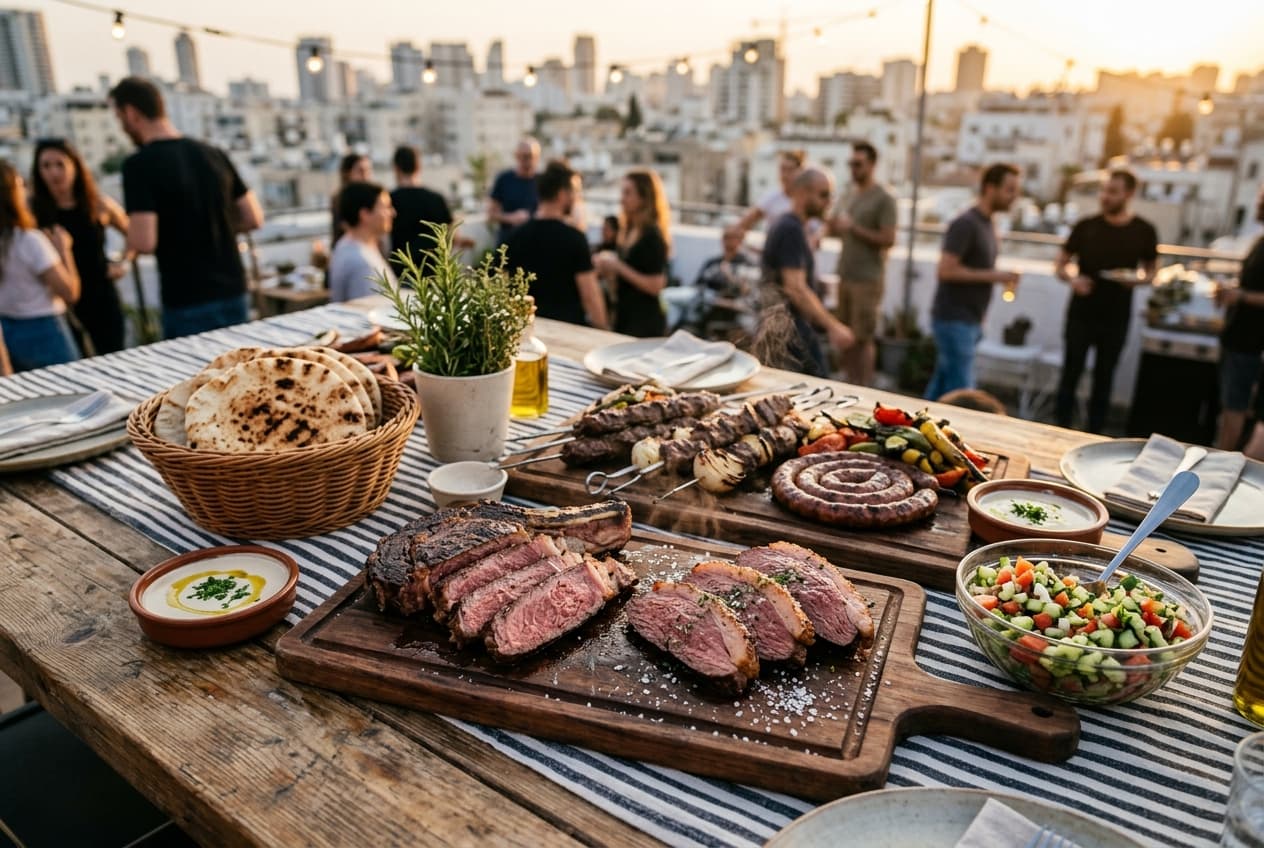
An event on live fire does the opposite. It is standing, moving and open-plan by nature. Guests circulate, drinks stay in hands, and the grill sits there as the loudest object in the space — smoke, sound, a chef working, food coming off the grate in waves. That is not decoration, it is social infrastructure. A guest who does not know anybody can walk over, watch a ribeye get turned, ask what the cut is, and be in a conversation inside thirty seconds without having to invent one. Every host who has run both formats knows the difference by the end of the first hour.
The practical arguments follow from the same thing. There is no venue to book months ahead, which matters because engagements tend to get planned in weeks rather than seasons. There is no minimum spend attached to a room. There is no closing time being enforced by a manager who wants the table back. And the event happens somewhere that already means something to the family, which photographs better than a function room and costs nothing extra.
Whose place does it run at, and will the space actually work?
The custom in many families is that the bride's side hosts. The reality is that it runs wherever there is outdoor space, and it is worth saying that out loud early rather than discovering it during a tense phone call. A garden in Ramat Gan, a rooftop in central Tel Aviv, a wide balcony in Ramat Aviv, a family house in Petah Tikva — the deciding factor is the space, not the protocol, and framing it that way spares everyone a negotiation nobody wants to be having in the first week of an engagement.
The hard requirement is single and non-negotiable: the grill needs an outdoor, ventilated space. Charcoal never runs inside a flat, a stairwell or an enclosed hall. Beyond that it needs a couple of metres of clear, non-flammable ground and a short unobstructed route from the fire to where food gets served. Send a photo of the space with your first message — that one photo is the whole feasibility check, and it takes us minutes rather than a site visit.
The second thing to check is capacity, and hosts consistently over-estimate it. A wide balcony holds roughly 8 to 16 people standing. A rooftop terrace comfortably takes 15 to 30. A private garden handles 25 to 40 without anyone eating in a corridor. If your list is 50 and your space is a rooftop, the honest answer is not more chairs — it is a bigger space or a shorter list. Two smaller notes for rooftops specifically: check the building rules before you commit to a date, and check which way the breeze runs, because a neighbour with a laundry line downwind of a charcoal grill becomes part of your evening.
The crew arrives about 90 minutes before the meal, builds the grill station, lays out starters, salads, breads and sauces, cooks through the event in waves, serves, and cleans everything down to the coals. Nobody in either family stands at a grill in the clothes they bought for the night, which is the entire point of hiring this rather than doing it yourself.
| Space | Comfortable standing capacity | What to check |
|---|---|---|
| Wide balcony | 8–16 | Clear non-flammable ground, neighbours, breeze direction |
| Rooftop terrace | 15–30 | Building rules, access for equipment, wind |
| Private garden | 25–40 | Level ground for the grill station, lighting after dark |
| Indoor flat or enclosed hall | Not for live fire | Charcoal needs open air — send a photo before booking |
How do you time the evening around the toast?
This is the part hosts get wrong, and it is fixable with one decision: food comes out before the speeches, not after. The instinct is to gather everyone, say the words, and then eat. In practice that means the room stands around hungry for forty minutes while stragglers arrive, the toast lands on a distracted crowd, and the grill has been holding food warm instead of doing what it is good at. Put the first wave out early. People with a drink in one hand and something on a napkin in the other are a far better audience than people waiting to be fed.
Build the schedule around the honest arrival curve. Israeli guests arrive across about forty minutes after the time on the invitation, and the people who arrive last are frequently the ones the toast is about. So: guests land, starters and the first cuts are already circulating, the room fills and mixes for roughly an hour, then the families speak once the space is genuinely full. After the toast is when the heavier premium cuts come off the grate — entrecôte, picanha, whatever the menu was built around — and that second wave restarts the evening rather than closing it.
One more thing worth deciding in advance: who speaks. An engagement party where four people give unplanned speeches runs long, and food does not improve while it waits. Two or three short ones, agreed between the families beforehand, is the version everyone remembers fondly.
| Time | What happens | What the crew is doing |
|---|---|---|
| T-90 min | Family is still getting dressed | Crew arrives, builds the grill station, lays out the table |
| T-0 | Invitation time, first guests arrive | Starters, salads and breads out, coals ready |
| T+20 min | Room filling, drinks moving | First wave off the grill, circulating on boards |
| T+60 min | Space is full — the toast | Grill holds, service pauses for the speeches |
| T+75 min | Second wave, the premium cuts | Entrecôte, picanha and skewers cooked to order |
| End | Guests leave, family sits down | Full cleanup, down to the coals |
What does the menu look like when everyone is standing?
It gets designed for one hand. That is the constraint a standing event puts on food, and it is the one most caterers ignore: a guest holding a glass has exactly one hand free, so a plated steak that needs a knife and a fork is a plate that ends up on a windowsill. Premium cuts get cooked whole for the crust and then sliced on wooden boards into strips you can take with your fingers or a small fork. Skewers, merguez and kebab work for the same reason. Pita, laffa, salads, tahini and sauces sit as a spread people return to between conversations rather than as a course that starts and ends.
Sourcing is where the money in a premium event actually goes, and it should be checkable. Our cuts are bought by name from butcher shops, and the butcher is written onto your quote rather than described with adjectives: Bat HaKatzav on Brodetzky in Ramat Aviv, a boutique kosher butcher with a long family lineage in dry-aged steaks and tomahawks; Roni Tassa's boutique butchery in Ramat Chen, Ramat Gan; and Atliz Lemhadrin in Kfar Shalem, which carries Badatz Machpud, Beit Yosef and Eda HaChareidis certification for families who hold a stricter standard.
Two menu notes specific to this event. Loading the menu with luxury cuts does move the per-guest price — the calculator on our homepage shows the effect as you tick them, rather than hiding it in a revision of the quote later. And check the other family's side of the list before you build the menu: an engagement party is the one event where you genuinely do not know half the guests, so ask both mothers for the vegetarian count, the allergies and the number of children. Grilled vegetables, halloumi-free vegetarian plates and simpler cuts for kids are planned in from the start, not improvised at the grill while forty people wait.
How do two families settle kashrut between them?
With one sentence, before the invitations go out: whichever family holds the stricter standard sets the standard for the night. That is not a religious ruling, it is event logistics — it is the only version where nobody has to stand at the table quietly deciding whether to eat. Have that conversation in week one of the planning, because it determines the sourcing, and sourcing is the part that cannot be changed on the day.
Then make the standard concrete rather than reassuring. Ask any caterer, including us, for the butcher's name and the certification in writing on the quote, and check it yourself against the Chief Rabbinate's public kosher databases. Those databases exist precisely so that no host has to take a caterer's word for anything. Where a family holds mehadrin, our answer is Atliz Lemhadrin in Kfar Shalem for the sourcing, plus an on-site mashgiach and a dedicated kashered grill arranged per event, on request — arranged for your specific date, which is the honest way to describe it, not a standing kitchen certificate we do not hold.
The thing to avoid is the middle position, where the meat is 'kosher' in a general sense and nobody has asked whose kosher. That is how you end up with a grandmother eating salad all night at her own grandchild's engagement party. Ask early, get it in writing, and the question disappears for the rest of the planning.
What does an engagement party cost — and what should it cost against the wedding?
From 20 guests, ₪290 per person, all-inclusive, with a ₪6,700 event minimum. All-inclusive means the quote is the invoice: premium cuts from butchers named on that quote, starters, salads, breads and sauces, soft drinks, the grill and the coals, the crew, live cooking through the event, service, and full cleanup. No setup fee, no staffing line, no cleanup line at the end of the night.
The ₪6,700 minimum binds up to about 23 guests, and above roughly 24 the per-head number multiplies straight out. Engagement parties tend to sit between 30 and 60 people, so: 30 guests is ₪8,700, 40 is ₪11,600, 50 is ₪14,500, 60 is ₪17,400. You can price your own headcount in the calculator on our homepage before sending anybody a message.
Now the part worth saying plainly, because it is arithmetic and not sales advice. The engagement party comes out of the same pot as the wedding, and per guest it costs roughly what a wedding guest costs — so the lever that moves this budget is the guest list, not the menu. Cutting 20 names saves ₪5,800. Downgrading the menu saves a fraction of that and is the one thing your guests will actually notice. If the number is uncomfortable, shorten the list to people who will be at the wedding anyway, and keep the food at the standard that made you consider live fire in the first place.
And if the honest version of this event is small — the two sets of parents, the couple, a sibling or two, one table, a real conversation rather than a party — that is the private-chef format instead: ₪1,900 for two, ₪2,700 for four, ₪3,500 for six. Same fire, same sourcing, sized for one table. A fair number of families do that first and hold the bigger celebration for the wedding.
| Guests | Price | How it's calculated |
|---|---|---|
| 2–6 (one table) | ₪1,900–₪3,500 | Private-chef format, published ladder |
| 20–23 | ₪6,700 | Event minimum applies |
| 30 | ₪8,700 | 30 × ₪290 |
| 40 | ₪11,600 | 40 × ₪290 |
| 50 | ₪14,500 | 50 × ₪290 |
| 60 | ₪17,400 | 60 × ₪290 |
How do you book it?
One message with four things: the date, a rough guest count, the address, and a photo of the garden, roof or balcony where the fire would stand. That is enough for a fixed quote with the butcher named on it — no site visit, no meeting, no sales call. Engagements get planned fast, and a date a few weeks out is priced exactly like a date three months out; there is no short-notice surcharge.
If you want to see how a live-fire event actually runs before you commit, read the about page. If the gathering is really a family dinner rather than a party, the private-chef page is the right one. And if the space cannot safely host charcoal, we will tell you that before you commit to anything, including to us. Mazal tov either way.
Frequently asked
How much does engagement party catering cost in Israel?
With RBBQ it is ₪290 per guest all-inclusive from 20 people — cuts from named butchers, starters, salads, breads, sauces, soft drinks, the grill, the crew, live cooking, service and full cleanup — with a ₪6,700 event minimum that covers up to about 23 guests. A 40-guest engagement party is ₪11,600 and 60 guests is ₪17,400. There is no setup fee and no short-notice surcharge.
Can an engagement party BBQ run on a rooftop or in a garden at home?
Yes, and that is the normal case — there is no venue to book and no minimum spend on a room. The one hard requirement is an outdoor, ventilated space for the grill, since charcoal never runs inside a flat or an enclosed hall. Plan on roughly 8–16 standing guests on a wide balcony, 15–30 on a rooftop terrace and 25–40 in a private garden, and send a photo of the space with your first message so it can be checked before anything is confirmed.
When should the toast happen — before or after the food?
Put the first wave of food out before the toast. Guests arrive across about forty minutes after the invitation time, so an early toast is delivered to a half-empty, hungry room. The version that works is starters and first cuts circulating from the start, the families speaking at around the one-hour mark when the space is genuinely full, and the heavier premium cuts coming off the grill straight after the speeches.
How do you handle kashrut when the two families keep different standards?
The workable rule is that whichever family holds the stricter standard sets the standard for the evening, and it should be agreed before the invitations go out because it determines the sourcing. Ask for the butcher's name and the certification in writing on the quote and verify it against the Chief Rabbinate's public kosher databases. For families holding mehadrin we source from Atliz Lemhadrin in Kfar Shalem, which carries Badatz Machpud, Beit Yosef and Eda HaChareidis certification, and an on-site mashgiach with a dedicated kashered grill can be arranged per event on request.
How many guests do you need for an engagement party BBQ?
The event format starts at 20 guests, with the ₪6,700 minimum covering up to about 23. Most engagement parties land between 30 and 60 people once both families and the couple's friends are counted. Below 20 the right format is the private chef instead: ₪1,900 for two, ₪2,700 for four and ₪3,500 for six, with the same fire and the same sourcing, sized for one table.