Hanukkah Company Party 2026: Live Fire Instead of Another Buffet
TL;DR
Hanukkah 2026 begins with the first candle on Friday evening, December 4, and ends at nightfall on Saturday, December 12. Strip out the two Shabbat-adjacent edges and you get exactly one full workweek of candle nights — Sunday, December 6 through Thursday, December 10 — which is the window every company in the country wants for its party. Thursday goes first every year; a Sunday-to-Wednesday evening is easier to book and usually better attended. A live-fire BBQ works in December better than people expect: cold is an argument for charcoal, not against it — sunset is around 16:40, the fire is lit by the time people walk out, and hot meat off the grill lands differently at 11 degrees than at 30. The one real question is rain, so the first message should say what covered, ventilated outdoor space the office has and what the rain plan is. Price is ₪290 per guest all-inclusive from 20 guests (from ₪315 with two premium cuts, from ₪340 with three or more), with a ₪6,700 event minimum covering teams up to about 23 people — one invoice that includes the meat from butchers named on the quote, starters, sides, soft drinks, crew, live cooking, service and cleanup, which is exactly the shape a year-end budget line wants. Book in October if you want a Thursday; November bookings take what is left.
Why is Hanukkah the party your company actually holds?
Most Israeli companies run one real event a year, and the calendar pushes it to December. Hanukkah gives the date a reason, the civil year-end gives it a deadline, and the finance department gives it a budget that expires on December 31. Those three forces land on the same two weeks, which is why every venue, caterer and crew in Gush Dan is booked solid for a handful of evenings while the rest of the winter sits quiet.
The format problem is that most Hanukkah parties are interchangeable: a rented hall, a DJ nobody asked for, catering trays that were filled at noon, sufganiyot at the end. People attend because attendance is noticed, and leave as early as leaving is polite. The event happens; nothing about it is remembered in January.
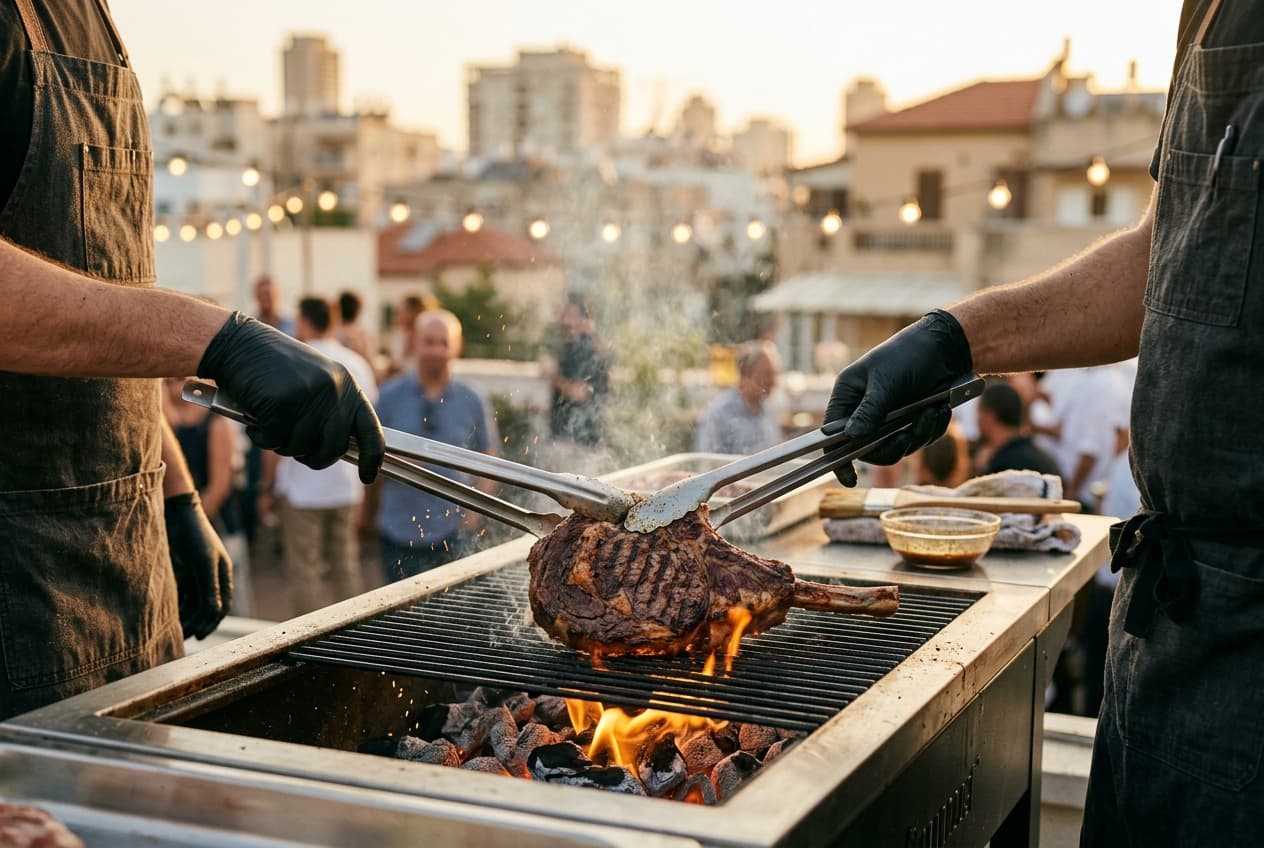
A live fire at the office flips the mechanics. The grill becomes the place people stand, food comes off in waves through the evening instead of all at once, and the crowd holds for two hours without an organized activity — because the activity is a chef cooking premium cuts over charcoal three meters away. It is also the rare company event where nobody from HR has to host: the crew runs setup, cooking, service and cleanup, so the person who booked it gets to attend it.
When exactly is Hanukkah 2026 — and which evening should the party be?
The first candle is lit on Friday evening, December 4, 2026, and the eighth day ends at nightfall on Saturday, December 12. For an office party, most of that is unusable: the first candle is Shabbat eve, the second is motzei Shabbat, and the eighth candle falls on Friday afternoon when the office is already empty. What remains is exactly one full workweek of candle nights — Sunday, December 6 through Thursday, December 10, candles three through seven.
Five evenings, and every company in the country wants the same ones. Thursday, December 10 goes first every single year, because it borrows the weekend — nobody has a 9:00 meeting the next day. It is also, honestly, not the best pick: Thursday parties lose the people who leave early for the weekend, and the slot costs you weeks of lead time. A Sunday-to-Wednesday evening is easier to secure, better attended, and the party is identical.
Two honest alternatives if the week is gone by the time you book. The week before Hanukkah — November 29 to December 3 — carries all the year-end energy with none of the calendar crush. And a party in the week after, from December 13, still reads as the company Hanukkah event even without candles to light; the budget deadline does not care which week it was spent in.
| Evening | Candle | Verdict for the office |
|---|---|---|
| Friday, Dec 4 | 1st | Shabbat eve — family night, not the company party |
| Saturday, Dec 5 | 2nd | Motzei Shabbat — possible, but a weekend ask for the team |
| Sunday, Dec 6 – Wednesday, Dec 9 | 3rd–6th | The smart slots: easier to book, best attendance |
| Thursday, Dec 10 | 7th | The most requested evening of the season — gone first |
| Friday, Dec 11 | 8th | Short Friday, office empties by noon |
| Nov 29 – Dec 3 / from Dec 13 | — | The overflow weeks — same party, no calendar fight |
Does a charcoal grill even work in December?
Better than in July, and it is worth saying why. Sunset in Tel Aviv in early December is around 16:40, so by the time the team walks out at six the fire is the brightest, warmest thing on the roof — a working charcoal grill throws serious heat, and the natural crowd behavior in winter is to stand near it, which is exactly where you want the crowd. Hot food also does more work in the cold: a slice of entrecôte straight off the grate lands differently at 11 degrees than it does in August, and the wave format means everything is eaten seconds after it leaves the fire, not lukewarm off a buffet.
The real December question is not cold, it is rain. Tel Aviv gets a real chance of rain in any given December week, and a charcoal fire needs a ventilated spot that stays dry. The good news is that the spot does not need to be open sky: a covered terrace with open sides, a roofed courtyard, a pergola, the building's covered parking level where it opens to the air — all of these work, because the requirement is ventilation, not exposure. What does not work is bringing the fire indoors.
So the honest planning rule for a December event: send a photo of the space with the first message and say what the rain fallback is — a covered corner of the same roof, the courtyard instead of the terrace, or a company that is relaxed about moving the date by a day or two. That conversation takes five minutes in November and saves the one phone call nobody wants on the morning of the party.
What does the evening look like — and where do the candles fit?
The crew arrives about 90 minutes before start: assemble the grill, bring the charcoal to an even working heat, dress the tables, plate the starters. From the first guest, the starters are already out — beef carpaccio bruschetta, merguez with dijon and harissa, mini arayes, fire-roasted eggplant with tahini — because an office party has the same forty-minute arrival curve as any other event, with people drifting up from their desks in waves.
The cooking then runs in waves through the evening: cuts come off the fire, get sliced across the grain onto wooden boards, and go straight to where people stand — then the next round goes on. One or two premium cuts play the centerpiece; kebab, pargit and merguez carry the volume. In a company crowd that mix matters, because the range of what people will actually eat is wide, and a skewer is a easier thing to hold through a conversation than a knife and fork.
The candles are the one moment the format hands you for free. Every party needs its assembly point — the CEO says a few words, someone thanks the team — and at a Hanukkah event that moment already exists: bring the office chanukiah out to the terrace, light it when the whole company is present, about 45 minutes in, and let the toast ride on it. On dessert, honesty: our desserts are pareve and made for a meat event; sufganiyot are a bakery's job, and the tray your office orders every year will sit perfectly well next to the coffee. We bring the fire, not the jelly doughnuts.
What does it cost — and why does finance like it?
₪290 per guest, all-inclusive, from 20 guests, with a ₪6,700 event minimum that covers teams up to about 23 people. All-inclusive means the quote is the invoice: the meat, bought by name from butchers written on the quote, the starters, salads, breads and sauces, soft drinks, the grill and coals, the crew — roughly one person per 15 to 20 guests — live cooking through the event, service and full cleanup. Loading premium cuts is the one thing that moves the number: two premium cuts takes it to ₪315 per guest, three or more to ₪340. There is no setup fee, no staffing line, no cleanup charge, and no December surcharge.
That shape is precisely what a year-end budget wants. The person defending the party internally has one number per head and zero surprise lines, which survives finance review in a way that 'venue plus catering plus staff plus cleaning, final total in January' does not. A 50-person company lands at ₪14,500 on the standard menu; an 80-person company at ₪23,200 — comparable to a restaurant buyout, except nobody books taxis and the office roof is the venue.
Two boundaries worth stating. Under 20 people, the event format stops making sense and the private chef format takes over — ₪1,900 for two, ₪2,700 for four, ₪3,500 for six; a small team dinner is a table, not an event. And we cook at your address across Tel Aviv, Gush Dan and the Sharon with no travel line and no out-of-city surcharge — the calculator on our homepage has no field for where the office is, which is the easiest way to verify that.
| Team size | Standard menu | With 3+ premium cuts |
|---|---|---|
| Up to ~23 | ₪6,700 (minimum) | ₪6,700–₪6,900 |
| 30 | ₪8,700 | ₪9,000 |
| 50 | ₪14,500 | ₪15,000 |
| 80 | ₪23,200 | ₪24,000 |
| 120 | ₪34,800 | ₪36,000 |
How does kosher work for a mixed team?
A company crowd is the most mixed crowd there is — the standard has to work for the most observant person on the team, or the party quietly excludes them. The way we handle that is sourcing you can check: the meat is bought by name from butchers who are written on your quote — Bat HaKatzav on Brodetzky in Ramat Aviv, a boutique butcher known for dry-aged steaks and tomahawks, and Meshek Lagziel in Ramat Gan, a sixty-year-old family business — so the answer to 'where is the meat from' is a name, not a shrug.
When the company needs a stricter, certified standard, we source from Atliz Lemhadrin in Kfar Shalem, which carries Badatz Machpud, Beit Yosef and Eda HaChareidis certification with an on-premise supervisor. For mehadrin-level events an on-site mashgiach and a dedicated kashered grill are arranged per event, quoted as their own line — RBBQ is a live-fire catering service, not a standing mehadrin kitchen with a permanent teudah, and we would rather say that plainly than imply otherwise. Whichever caterer you use, ask for the butcher and certification in writing and check the name against the Chief Rabbinate's public kosher database.
Everything on the fire is meat, so there is no dairy at the event at all — one category of problem removed before it starts. Vegetarians on the team are covered by the mezze side of the menu: fire-roasted vegetables, salads, breads, tahini. Tell us the count in the first message rather than the fact that there are some, and it gets built in rather than improvised.
When should you book, and what goes in the first message?
Work backwards from the calendar above. Five workday candle nights, every company in Gush Dan competing for them, Thursday gone first: the companies that get the evening they wanted book in October. By mid-November the choice is usually between a Sunday and the overflow weeks. There is no premium for booking early and no penalty for the date itself — a 50% deposit holds it, and the headcount can move until a few days before, so waiting for the final RSVP list is the one mistake that costs the date.
The first WhatsApp message needs five things: rough headcount, the evening you want (with a fallback), the office address, a photo of the roof, terrace or courtyard where the fire would stand, and — because it is December — what the covered option is if it rains. Add the kosher standard by name if the team needs one. The photo answers surface, ventilation, access and size in one glance, which is why most office setups get confirmed in that first conversation.
What comes back is a fixed quote with the butcher named on it and one all-inclusive number for your headcount. You can sanity-check the number yourself first — the calculator on our homepage prices any headcount in ten seconds, and our about page shows how the evening actually runs. Then the only thing left to fight about internally is Sunday versus Wednesday.
Frequently asked
When is Hanukkah 2026?
The first candle is lit on Friday evening, December 4, 2026, and the holiday ends at nightfall on Saturday, December 12. For a company party the practical window is the one full workweek of candle nights inside it: Sunday, December 6 through Thursday, December 10.
Which evening of Hanukkah is best for a company party?
Thursday, December 10 is the most requested evening of the season and disappears first, but a Sunday-to-Wednesday candle night (December 6–9) is usually the better event: easier to book and better attended, because Thursday parties lose the people who leave early for the weekend. The week before Hanukkah and the week after both work as overflow — the party reads the same.
Does a BBQ party work outdoors in December?
Yes — arguably better than in summer. Sunset is around 16:40, so the fire is the warmest, brightest point of the evening, and hot meat straight off the grill does more work at 11 degrees than at 30. The one real risk is rain: the grill needs a ventilated spot that stays dry, and a covered terrace with open sides, a roofed courtyard or a pergola all qualify. Send a photo of the space and name the rain fallback in the first message.
How much does a company Hanukkah party cost per employee?
₪290 per guest all-inclusive from 20 guests — meat from butchers named on the quote, starters, sides, soft drinks, crew, live cooking, service and cleanup — rising to ₪315 with two premium cuts and ₪340 with three or more. The ₪6,700 event minimum covers teams up to about 23 people. A 50-person party on the standard menu is ₪14,500, with no setup, staffing, cleanup or December surcharge.
Can the party be kosher for a mixed team?
The meat is bought by name from butchers written on the quote, and for a stricter certified standard we source from Atliz Lemhadrin in Kfar Shalem, which carries Badatz Machpud, Beit Yosef and Eda HaChareidis certification. An on-site mashgiach and dedicated kashered grill are arranged per event on request and quoted as their own line. Everything on the fire is meat, so there is no dairy at the event; state the standard by name when booking and verify the certification in writing.
What if the office has no outdoor space?
The format moves rather than dies: a rented rooftop, a garden venue or a founder's home all work, and the crew brings everything. The tradeoff is attendance — people skip what requires a commute — so check the office building first: a roof deck, wide balcony, courtyard or covered parking level that opens to the air all qualify.
How far ahead should we book a Hanukkah party date?
Book in October for a real choice of evenings; the Thursday slot goes first every year. A 50% deposit holds the date and the headcount can be adjusted until a few days before the event, so there is no reason to wait for the final attendance list.
Do you bring sufganiyot?
No — and honestly, you do not want a grill crew's sufganiyot. Our desserts are pareve and built for a meat event; sufganiyot are a bakery's craft, and the tray your office orders every year will sit perfectly next to the coffee. We bring the fire.