On-Site BBQ vs Delivery Catering: Which Wins?
TL;DR
Delivery catering and on-site BBQ are not two prices for the same product; they are two different products. Delivered trays are cooked hours before your event and win on simplicity: short office lunches, small tables, tight budgets, venues where fire is impossible. On-site catering cooks through the event itself — at RBBQ that is ₪290 per guest all-inclusive with a ₪6,700 event minimum — and wins whenever the event runs longer than an hour, because food made in waves at 9pm matches the first plate served at 7. Decide by event length and what the food is for, then compare what each quote actually includes rather than the headline number.
What actually separates on-site catering from delivery?
The hour the food is cooked. A delivered order leaves a kitchen somewhere in the city, rides in a warming box, and lands on your table sealed in foil trays. However good that kitchen is, everything in the tray was finished before your event started, and it all reaches the table at once. On-site catering reverses this: the kitchen comes to you, the fire is lit at your venue, and cooking runs through the event instead of before it.
That one difference drives everything else people notice. Grilled meat is the single worst food to cook ahead: a skewer that left the fire forty minutes ago and travelled across Tel Aviv is a different dish from one that left it forty seconds ago. It is why delivered BBQ so often disappoints people who ordered well, and why the format matters more than the menu.
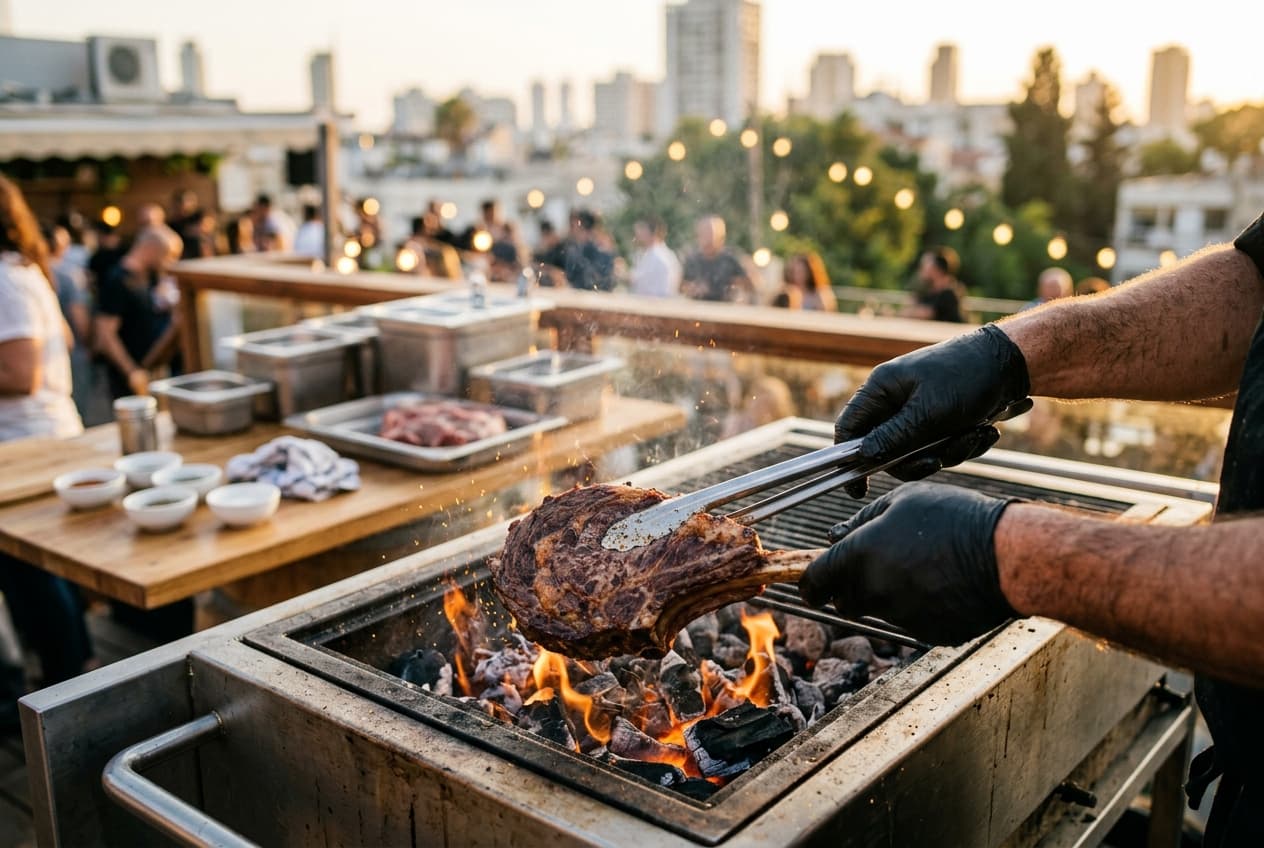
It also changes what the guests experience. A tray on a table is logistics; a chef working coals in front of your guests is part of the event. The smell of the fire, the cuts going on in waves, the plate handed over the pass — at most events we cater, the grill corner is where people stand all evening.
Which is cheaper — and what is inside each price?
The headline number will almost always favour delivery, and comparing headline numbers is exactly the mistake. A delivery quote is a food price: trays, disposables, a driver. Everything that turns food into an event — someone to set up, serve, keep the buffet moving and clean up — is either your job that evening or a line item added later. Hosts who ordered trays for sixty people discover this at the event, usually while carrying foil pans instead of talking to their guests.
An on-site quote should be an event price. Ours is ₪290 per guest, all-inclusive: premium cuts from named certified butchers, starters, sides, breads, sauces, drinks, the crew, the fire, live cooking in waves, service through the event, and full cleanup, with a ₪6,700 event minimum that binds up to about twenty-three guests. There is no setup fee or cleanup fee layered on top, and you can build your own headcount into a live number in the calculator on our homepage.
So the honest comparison is not ₪X per tray against ₪290 per guest. It is: what does the evening cost once both formats include the same things — and who is doing the serving, the reheating and the washing up at your own event.
| Delivery trays | On-site BBQ (RBBQ) | |
|---|---|---|
| When the food is cooked | Hours before, off-site | Live, in waves, through the event |
| Serving and staff | Usually you, or billed extra | Crew included, one per 15–20 guests |
| Setup and cleanup | Yours | Included — crew arrives ~90 min ahead, leaves with the mess |
| Guest experience | A buffet table | Open fire, chef cooking in front of guests |
| Best at | Short, simple, small | Events longer than an hour |
When does delivery genuinely win?
A weekday office lunch, eaten in thirty minutes at desks, does not need a fire crew. Delivery was built for exactly this: short, functional meals where the food is fuel and the event ends before hot food would have mattered. If everyone eats at the same time within half an hour of arrival, cooked-ahead food is at its least-bad, and the price difference is real money.
Delivery also wins by default in a few situations. Under twenty guests, our event format does not run at all — the ₪6,700 minimum and twenty-guest floor exist because a fire crew below that size makes no economic sense for you (a small table is private-chef territory, a different product with its own pricing). No balcony, rooftop, courtyard or garden at the venue means no ventilated spot for coals, and no fire. And when the budget is genuinely the whole decision, trays feed more people for less.
We would rather say that plainly than win a comparison by hiding the cases we lose. If your event is a short lunch for fifteen in a closed office, order trays from a good kosher kitchen and spend the difference elsewhere.
When does on-site clearly win?
The moment your event runs longer than an hour, cooked-ahead food starts losing. A wedding reception, a bar mitzvah, a corporate evening on a rooftop — guests eat across two or three hours, and a tray that was hot for the first circle of guests is congealing for the third. Cooking in waves is the only format where the person eating at 9pm gets the same plate as the person who ate at 7. That is not a premium flourish; for a long event it is the difference between food that works and food that ran out of time.
On-site also wins wherever the sourcing has to survive scrutiny. Trays arrive anonymous; nobody at the table knows whose meat it was. Our cuts are bought by name from certified butchers — Bat HaKatzav in Ramat Aviv, Meshek Lagziel in Ramat Gan, and for stricter events Atliz Lemhadrin in Kfar Shalem, which carries Badatz Machpud, Beit Yosef and Eda HaChareidis certification — and the butcher goes on your quote in writing. Kosher events can add an on-site mashgiach and a dedicated kashered grill on request; verify certification on paper rather than assuming it, with us or with anyone.
And it wins when the food is meant to be part of the event rather than the intermission. A live fire gives guests somewhere to gather, something to watch and something to talk about. You are not paying ₪290 a head for calories; you are paying for the hour of the evening the food would otherwise have lost, plus the show.
How do you actually decide?
Ask three questions in order. How long will people be eating — under an hour, delivery survives; over it, live fire pulls ahead fast. Is there a ventilated outdoor spot — a balcony, roof, garden or courtyard is all we need, but it is a hard requirement. And what is the food for — fuel for a working lunch, or the centre of a celebration.
Then make both quotes comparable before you compare them. Add to the delivery number whatever it leaves out: serving staff, setup, disposables worth using, and the hours of your own evening that go into running the buffet. Strip nothing from the on-site number — if a caterer quotes on-site with separate fees for setup, staff or cleanup, that is a delivery price wearing an event costume.
If your event is in Tel Aviv or Gush Dan, you can read how we run a live-fire event on our about page, price your headcount in the homepage calculator, and send the date on WhatsApp for a fixed quote with the butcher named on it. And if what you describe is honestly a delivery event, we will tell you so.
Frequently asked
Is delivery catering cheaper than on-site catering?
Per tray, usually yes. Per event, often not by as much as the quotes suggest: a delivery price covers food and a driver, while serving staff, setup, disposables and cleanup are either extra or your own work. An on-site price like RBBQ's ₪290 per guest includes the crew, live cooking, service and full cleanup. Compare the two only after adding to the delivery quote everything it leaves out.
When is delivery the right choice over on-site BBQ?
Short meals where everyone eats at once — a thirty-minute office lunch, a small daytime gathering — and any event under 20 guests, below a ₪6,700 budget, or at a venue with no ventilated outdoor spot for a grill. In those cases cooked-ahead trays are the honest recommendation.
Why does event length matter so much in this comparison?
Because delivered food is all finished before the event starts, it is at its best for the first guests and degrades from there. On-site cooking runs in waves, so a guest eating two hours in gets the same plate as the first one. Under an hour the difference is small; over an hour it grows every minute.
Can on-site BBQ catering be kosher like a delivery from a kosher kitchen?
Yes, and more verifiably. Cuts come from certified butchers named on the quote — Bat HaKatzav in Ramat Aviv, Meshek Lagziel in Ramat Gan, or Atliz Lemhadrin in Kfar Shalem (Badatz Machpud, Beit Yosef, Eda HaChareidis) for stricter standards — with a mashgiach and dedicated kashered grill arrangeable on request. Always verify certification in writing rather than assuming it.
What does on-site catering need from my venue that delivery doesn't?
One ventilated outdoor spot for the fire — a rooftop, balcony, garden or courtyard — and roughly 90 minutes of access before guests arrive for the crew to set up. Delivery needs neither, which is precisely why it wins at venues where fire is impossible.