
Booking a Private Chef in Tel Aviv as an English Speaker
TL;DR
Hiring a private chef in Tel Aviv is straightforward once you know four things that are different from the US, the UK or France. Booking happens on WhatsApp, not through a form or an email thread, and a same-day reply is normal. The price you are quoted already includes 18% VAT and there is no service charge or expected tip on top: a private fire dinner is ₪1,900 for two, ₪2,700 for four and ₪3,500 for six, priced per guest up to about ten, and above 20 guests it becomes event catering at ₪290 per guest all-inclusive with a ₪6,700 event minimum. The word kosher on its own is not a specification — you need to name a standard, and the butcher and its certification should appear in writing on your quote. And a Tel Aviv apartment brings its own constraints: charcoal needs real outdoor ventilation, the building's va'ad may need warning, and the city gets quiet around 23:00.
Why is this different from booking a private chef back home?
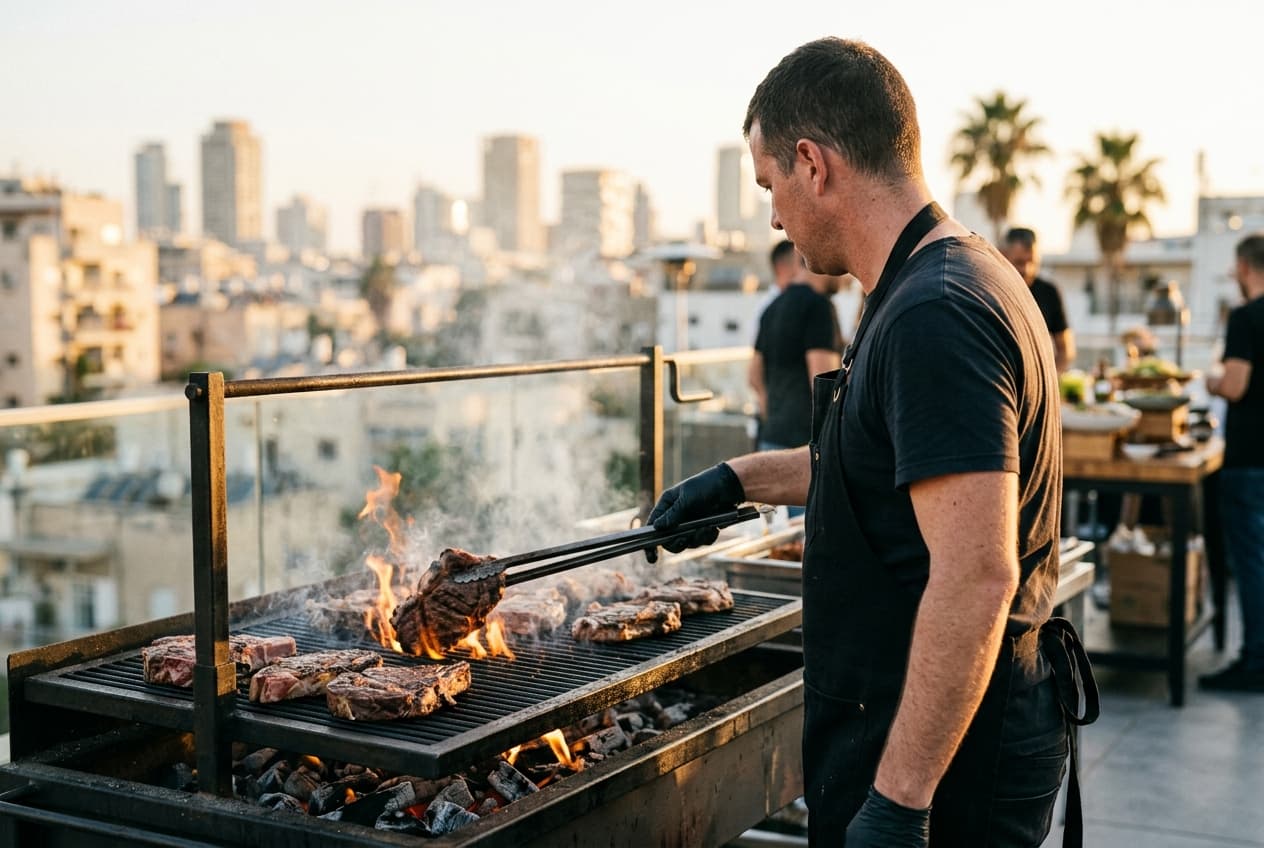
Not because the cooking is different. A grill chef comes to your apartment, rooftop or garden, lights real charcoal, cooks a multi-course meal in front of your guests and cleans up afterwards. That part reads the same in any language.
What is different is the layer around it. In the US or the UK you would expect a website form, an emailed contract, a price before tax, a gratuity line and a menu that assumes butter and cheese are available. In Israel almost none of that holds. Bookings run on WhatsApp, the advertised price is the final price, tipping a catering crew is not a norm, and if the event is kosher there is no dairy in the building that night — not on the steak, not on a cheese board, not in the dessert.
Every one of those is easy to work with once someone tells you. The problem is that nobody usually does, because the local market writes for locals. This page is the version nobody wrote: the practical mechanics of hiring a private chef in Tel Aviv when you did not grow up here. If you want the format itself explained rather than the logistics, our private chef page and the cost guide on this blog cover that.
How do you actually book — email, a form, or WhatsApp?
WhatsApp, and this genuinely surprises people. In Israel WhatsApp is not a casual channel that sits below email; it is the business channel. Quotes, dates, guest counts, menu changes and the deposit conversation all happen there. Our number is 055-257-4435, and the buttons on this site open a message with your details already filled in. Email works too — hello@rbbq.co.il — it is simply slower, because it is not where anyone is looking.
The pace is faster than you are used to and less formal than you expect. A reply the same day is normal, including in the evening. A quote is a written message with numbers in it rather than a designed PDF with a cover page. That informality is not a lack of seriousness; the commitment lives in the deposit, and a 50% deposit is what actually holds a date.
It also means the first message you send does most of the work. Date, rough guest count, the address or at least the neighbourhood, whether the space is a balcony, roof, garden or courtyard, whether it needs to be kosher and at what standard, and any allergies or non-meat eaters at the table. Send a photo of the space. Six lines and a photo will usually get you a real number back rather than a request for a phone call.
| Step | In Israel | Why |
|---|---|---|
| First contact | WhatsApp message | The default business channel here, not a casual one |
| Response time | Usually same day, often within hours | Small crew, phone-first market |
| The quote | A written message with the numbers | Formal PDFs are the exception, not the rule |
| Holding the date | 50% deposit | The deposit is the commitment, not the paperwork |
| Final headcount | Can move until a few days before | Shopping happens close to the event |
| Payment | Balance around the event | Quoted figure is the final figure |
Is the price I am quoted the price I pay?
Yes, and this is worth stating plainly because it cuts the other way from what most English speakers expect. Israeli consumer prices are quoted including VAT, currently 18%. There is no tax added at the end. There is also no service charge and no expected gratuity for a catering crew — tipping culture here applies to restaurant table service, not to a chef you hired directly. When we say ₪1,900 for a dinner for two, ₪1,900 is what leaves your account.
The private chef ladder is ₪1,900 for two, ₪2,700 for four and ₪3,500 for six, priced per guest up to about ten. That covers the menu built with you in advance, the premium cuts, the starters, sides and sauces, the chef, the grill, the charcoal, service through the evening and the cleanup. You are not renting equipment separately and you are not paying a setup fee.
Above roughly ten guests the right format stops being a private chef and starts being event catering, which begins at 20 guests: ₪290 per guest all-inclusive, ₪315 if you load the menu with two premium cuts, ₪340 with three or more, and a ₪6,700 event minimum that binds up to about 23 people. So a 40-guest garden party on a standard menu is ₪11,600. You can run those numbers yourself on the calculator on our homepage before you talk to anyone — it is the same model that produces the quote.
One honest gap: between about ten and twenty guests there is no clean answer, and anyone who gives you a slick one is guessing. It is too many people for one chef working a single fire at a table, and it sits under the event minimum, which means a 14-guest event effectively pays the 23-guest floor. That is worth knowing before you build a guest list rather than after.
There is no travel surcharge across Tel Aviv, Gush Dan and the Sharon. The calculator has no field for your address, which is the simplest possible proof that distance is not in the price.
| Guests | Format | Price |
|---|---|---|
| 2 | Private fire chef | ₪1,900 |
| 4 | Private fire chef | ₪2,700 |
| 6 | Private fire chef | ₪3,500 |
| Up to ~10 | Private fire chef | Priced per guest |
| 10–20 | The awkward gap | Under the event minimum — ask with the date |
| 20 | Event catering | ₪6,700 (the event minimum) |
| 40 | Event catering | ₪11,600 standard menu |
| 60 | Event catering | ₪17,400 standard menu |
What does kosher actually mean when I am asked to specify it?
It means you have to say more than the word. Kosher in Israel is a spectrum of standards rather than a single switch, and a caterer who says kosher without naming one has told you nothing. The practical vocabulary is short. Rabbanut is the local municipal rabbinate certification and is the common baseline. Mehadrin means a stricter standard. Badatz refers to independent private certifying bodies — Machpud, Beit Yosef and Eda HaChareidis are three you will see on labels — and each has its own standard. Chalak, roughly what is sold abroad as glatt, is a specification about the lung of the animal and is a separate question from who certified it.
The way to use this is to ask what your guests need, not what sounds most impressive. A mixed secular table usually needs nothing beyond meat from a certified butcher and no dairy served. Observant guests will tell you their standard if you ask, and family members who keep a stricter standard than the host set the bar for the room. Then get it in writing: the butcher's name and its certifying body should appear on your quote, and you can check that shop yourself against the Chief Rabbinate's public kosher business database before you pay a deposit.
For our own events the butchers are named. We buy from Bat HaKatzav on Brodetzky 43 in Ramat Aviv, Meshek Lagziel and Roni Tassa's boutique butchery in Ramat Gan, and for mehadrin requests from Atliz Lemhadrin on Tzora 3 in Kfar Shalem, which carries Badatz Machpud, Beit Yosef and Eda HaChareidis certification. A mehadrin event also means an on-site mashgiach and a kashered grill, arranged per event and quoted as its own line rather than folded into the per-guest number.
The consequence that catches Anglo hosts hardest is not the meat, it is the dairy. A kosher meat meal means no dairy anywhere in the meal: no butter finishing the steak, no cheese course, no cream in the dessert, no milk in the coffee afterwards. Our desserts are pareve for exactly this reason. If you were mentally planning a cheese board, plan something else — this is the one constraint that reliably ambushes people who are new to it.
Will my Tel Aviv apartment even work for this?
Usually yes, and the deciding factor is ventilation rather than square metres. Charcoal produces smoke and carbon monoxide, so the grill has to stand somewhere genuinely open — a balcony, a roof terrace, a courtyard, a garden. There is no version of this that happens in a closed kitchen, and any chef who offers one is a chef you should not hire.
Beyond that, Tel Aviv buildings have their own quirks. Older Bauhaus blocks in the Old North and Lev Ha'ir often have no lift and no service entrance, which matters when a grill, coolers and charcoal have to come up. Roof access is frequently shared and controlled by the va'ad bayit, the building's house committee, so if the roof is not exclusively yours, ask before you book rather than on the night. Street parking near the entrance for the unloading window is a real constraint in Florentin and Neve Tzedek. And Tel Aviv is dense: neighbours are close, and municipal quiet hours mean a rooftop event should be winding down around 23:00 on a weeknight.
None of this is a reason to move the event to a venue. It is a reason to send a photo of the space in your first message. We would rather tell you honestly that a particular balcony is too enclosed than turn up and discover it. Gardens in Ramat Aviv, Herzliya and the Sharon suburbs are the easy case — flat ground, a gate, and nobody to consult.
| Check | What matters | How to answer it fast |
|---|---|---|
| Ventilation | Genuinely open air — hard requirement | Photo of the balcony, roof or garden |
| Roof access | Shared roofs are the va'ad's call | Ask the va'ad before confirming a date |
| Getting equipment up | Stairs, lift width, service entrance | Say which floor and whether there is a lift |
| Unloading | Somewhere to stop near the entrance | Name the street and whether parking is possible |
| Neighbours and noise | Quiet from around 23:00 on weeknights | Plan the end time when you plan the start |
| Flat, non-flammable spot | Grill needs stable ground and clearance | Tiles, stone or concrete — not decking under an awning |
How does the Israeli calendar change when I can book?
More than you would expect, and in ways a foreign calendar app will not warn you about. Shabbat runs from sundown Friday to nightfall Saturday, which removes most of the weekend from an observant guest list and makes Thursday night the real social night out here. Friday afternoon is the classic Israeli hosting slot, but for observant guests it has to finish before candle-lighting, which in December is startlingly early.
The Jewish holidays move against the Gregorian calendar every year, so the dates you learned last year are wrong this year. The Tishrei run in September and October — Rosh Hashana, Yom Kippur, Sukkot — is the densest hosting season of the year, and it books out weeks ahead. Passover in spring is the other pressure point, and it also changes what can be cooked and served. Yom Ha'atzmaut in the spring is the single biggest grilling day in the country, and it is not a day to try to book late.
The practical rule is simple: for an ordinary evening a couple of weeks is comfortable, and for anything in a holiday window you want to be a month or more ahead. If you are new here and unsure whether your chosen date collides with something, ask when you send the first message — it is a normal question and the answer takes one line.
What actually lands on the table?
Premium cuts cooked to temperature over charcoal, plus everything around them. The steaks are entrecôte, picanha, tomahawk, sirloin, Denver and flat iron; the grill items are the Israeli half of the meal — pargit, kebab, merguez, wings, arayes and skewers. Starters, salads, breads, house sauces and hot sides come off the same fire, and dessert is pareve so it works at a meat meal.
If somebody at the table does not eat meat, say so at the quoting stage rather than on the night. Fish is a substitution rather than an extra course: named guests eat salmon, sea bass or denis instead of meat, which is how it should be counted. Vegetarians and allergies work the same way — they are a menu-building input, not an emergency.
One useful expectation to reset: this is not plated restaurant service. Food comes out in waves, off the fire, sliced on boards, and people eat as it arrives. That is the format working, not the format failing. If your event is standing and mingling, that pattern is better than a seated service anyway, because everything can be eaten one-handed.
Frequently asked
Do you speak English?
Yes. The whole booking process, the menu conversation and the event itself run in English if that is easier for you. Hebrew, obviously, too — say which you prefer in the first message and that is the one we use.
How much does a private chef cost in Tel Aviv?
₪1,900 for two, ₪2,700 for four and ₪3,500 for six, all-inclusive, priced per guest up to about ten. Above 20 guests it becomes event catering at ₪290 per guest all-inclusive, with a ₪6,700 event minimum that binds up to about 23 people. Every figure already includes 18% VAT and nothing is added afterwards.
Should I tip the chef and the crew?
There is no expected tip. Tipping culture in Israel applies to restaurant table service, not to a private chef or a catering crew you hired directly. The quoted price is the whole cost. If you want to tip because the evening went well, it will be appreciated and it is genuinely not expected.
Is VAT included in the price?
Yes. Israeli prices are quoted including VAT, currently 18%, and consumer-facing figures on this site are the final figures. There is no tax line added at checkout the way there would be in the US.
Can you do this in my apartment if I only have a small balcony?
Often yes, if the balcony is genuinely open air rather than enclosed or glassed in. Charcoal needs real ventilation and there is no indoor version of it. Send a photo of the balcony on WhatsApp and you will get an honest answer before you commit to anything.
How far ahead should I book?
A couple of weeks is comfortable for an ordinary evening. For anything in the Tishrei holiday run in September and October, around Passover, or on Yom Ha'atzmaut, plan a month or more ahead — those windows fill early and a late request is often a genuine no.
What do you need from me to send a quote?
Date, rough guest count, the address or neighbourhood, what kind of space it is, whether it needs to be kosher and at what standard, and any allergies or guests who do not eat meat. A photo of the balcony, roof or garden answers more questions than a paragraph of description.