Shabbat Bar Mitzvah Catering: Which Meal Gets the Fire
TL;DR
Nobody lights a grill on Shabbat, so the useful question is not whether a BBQ caterer can do your bar mitzvah Shabbat, it is which of the weekend's meals is worth the fire. Two of them are: Friday afternoon, cooked and eaten hot before candle-lighting, and motzaei Shabbat once Shabbat is out. The season decides which. In late June, Tel Aviv candle-lighting is 19:30 and havdalah 20:33, so Friday afternoon is long and easy while a motzaei Shabbat party does not see food before about 22:00. In mid-December candle-lighting is 16:19 and havdalah 17:19, which makes Friday afternoon a rushed 14:00 lunch and motzaei Shabbat the obvious party. Shabbat lunch itself, the shul kiddush and seudah shlishit are not ours and never will be. Pricing is ₪290 per guest all-inclusive from 20 guests, a ₪6,700 event minimum that binds up to about 23 people, and children at 55% of a portion, which matters when thirty of your guests are thirteen. All figures include 18% VAT.
Which meals of a bar mitzvah Shabbat can actually be cooked on fire?
Two of them. That is the whole answer, and it is worth having before you start comparing caterers rather than after you have paid a deposit. We do not work from candle-lighting to havdalah, which means the meals at the centre of a bar mitzvah Shabbat, the Friday night dinner and the Shabbat lunch after shul, cannot be cooked by us or by anyone else working live fire. Any caterer who tells you otherwise is either not cooking on-site or not keeping Shabbat, and you should establish which before the conversation goes further.
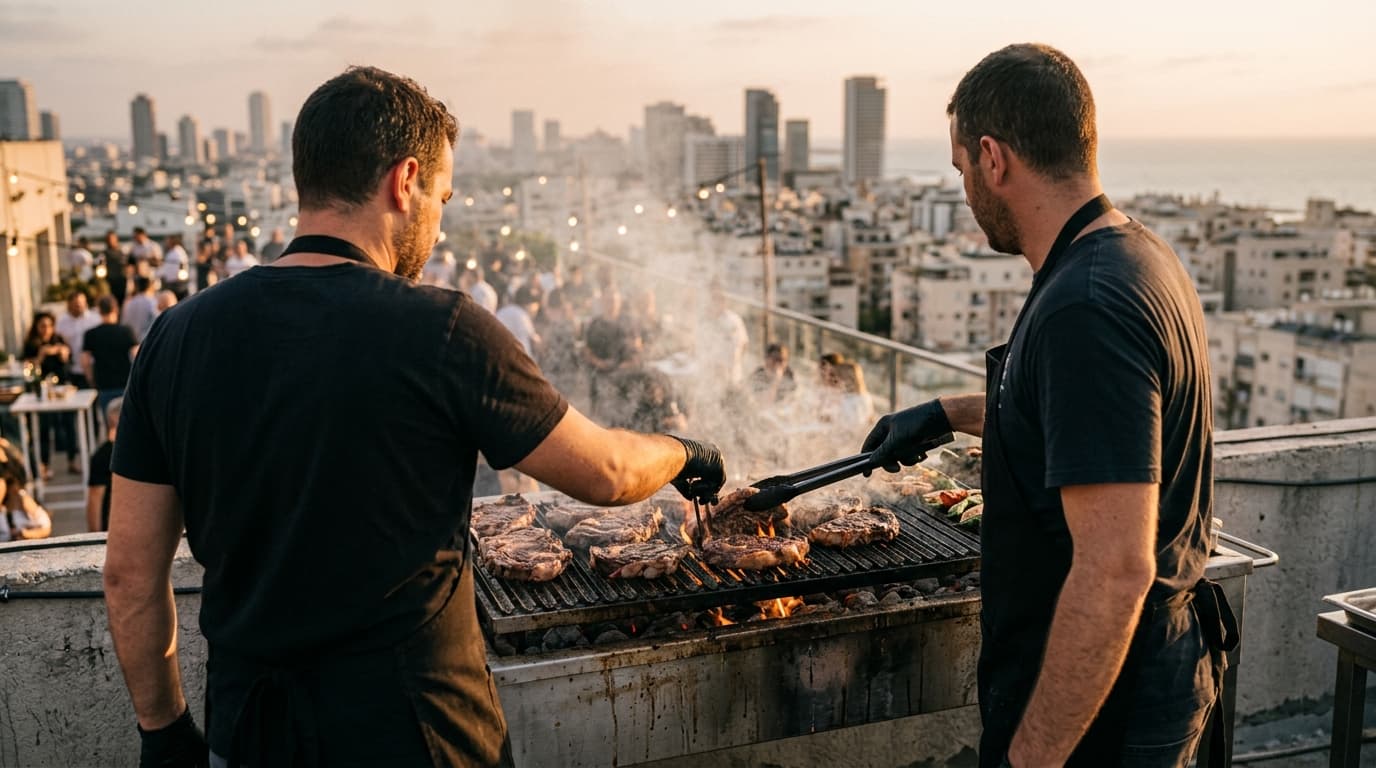
What is left is genuinely good, and it is more than families expect. Friday afternoon is a real meal: the crew arrives around midday, the fire runs through the afternoon, food comes off it in waves and is eaten hot, and everything is packed and gone well before candle-lighting. Motzaei Shabbat is the other one, and at a bar mitzvah it is usually the party rather than the meal, which suits a grill better than a seated lunch does. Both of those are ours. Neither of them is Shabbat.
Then there are the two that nobody puts on the plan and both of which are worth putting on it. Thursday night, when the out-of-town family lands and the house is suddenly full, is the quietest and often the best-value evening of the whole weekend. Sunday brunch, for the relatives who stayed over, is the other. Neither carries any of the pressure of the main event and both are ordinary weekdays as far as the fire is concerned.
The table below is the honest version of the weekend. It is worth reading before you book a hall, because two or three of the rows are decisions you are making by accident right now.
| Occasion | Can we cook it? | What happens instead |
|---|---|---|
| Thursday night, family arrives | Yes | An ordinary weekday. The quiet one nobody plans |
| Friday afternoon, before candles | Yes | Cooked and eaten hot, crew packed and gone before candle-lighting |
| Friday night dinner | No | Shabbat is in. A traditional caterer cooks ahead and serves cold or warmed |
| Shabbat morning kiddush at shul | No | A shul kiddush, usually dairy or pareve. Not our product at all |
| Shabbat lunch after shul | No | The big meal, and the one a live-fire caterer cannot touch |
| Seudah shlishit | No | Still Shabbat |
| Motzaei Shabbat | Yes | Setup starts after havdalah. Usually the party |
| Sunday brunch | Yes | For the guests who stayed. An ordinary weekday |
Friday afternoon or motzaei Shabbat, and why the season decides it
Because the Israeli clock moves by nearly three and a half hours between midwinter and midsummer, and the two windows move in opposite directions with it. This is the single most useful paragraph in the post and almost nobody plans around it.
Take a summer bar mitzvah. In late June, candle-lighting in Tel Aviv is 19:30 and havdalah is 20:33. Friday afternoon is enormous: the crew can set up at midday, the fire is at temperature by two, guests eat from five, and everything is cleared with hours to spare. The same weekend's motzaei Shabbat is difficult, because the crew genuinely cannot set up during Shabbat. Setup starts at 20:33, the first food off the fire lands around 22:00, and you are asking a room containing thirty thirteen-year-olds and a set of grandparents to hold on until then.
Now take a winter one. In mid-December, candle-lighting in Tel Aviv is 16:19 and havdalah is 17:19. Friday afternoon has collapsed into a rushed 14:00 lunch that has to be cleared by half past three, which is a strange hour to feed a hundred people and a worse one to ask them to travel for. But motzaei Shabbat has become excellent: Shabbat is out at 17:19, setup begins immediately, food starts coming off the fire around 18:45, and the party runs at a completely civilised hour with the kids still awake for it.
So the rule of thumb is the opposite of what most families guess. A summer bar mitzvah wants Friday afternoon. A winter one wants motzaei Shabbat. If you tell us the date in the first message we will tell you which one your weekend is, along with the actual candle-lighting and havdalah times for that specific Shabbat rather than the seasonal approximation above.
| Season | Candles / havdalah | Friday afternoon | Motzaei Shabbat |
|---|---|---|---|
| Late June | 19:30 / 20:33 | Excellent. Guests eat from 17:00 | Hard. First food around 22:00 |
| Mid-December | 16:19 / 17:19 | Rushed. A 14:00 lunch, cleared by 15:30 | Excellent. Food from about 18:45 |
| Spring and autumn | Between the two | Workable | Workable |
What about the kiddush in shul on Shabbat morning?
That one is not ours, and saying so plainly saves everyone a week. The kiddush after the boy's aliyah happens in the shul hall, on Shabbat, and it is the single occasion in the weekend that has nothing to do with a grill. There is no version of this we can do and there is no version we would like to sell you.
It is also usually a different kind of food entirely. A shul kiddush is herring, kugel, crackers, cakes, whisky and a lot of standing up, and in many shuls it is dairy or pareve rather than meat, which puts it outside what we cook before the Shabbat question even arises. The people who do it well are the shul's own kiddush committee, a local kiddush caterer, or, very often, the family with a lot of shopping and two long Thursday evenings.
The same goes for the Friday night dinner and the Shabbat lunch. The trade solution for those is a traditional caterer who cooks on Thursday, delivers before Shabbat, and serves food either cold or warmed on a plata. That is a real and respectable product, it is just not this one, and the difference matters: what you are buying from us is the fire in front of your guests, and a plata is by definition the absence of it.
Where this leaves a family is usually with a split weekend, and there is nothing wrong with that. A traditional caterer takes the two Shabbat meals, the shul takes the kiddush, and we take whichever of Friday afternoon or motzaei Shabbat the season points at. The mistake is the other one, where somebody quietly promises a live fire on Shabbat and the family discovers what that actually means on the day.
How are the teenagers counted, and what do they actually eat?
At 55% of a portion, and at a bar mitzvah this changes the number more than the menu does. A bar mitzvah is the one event where the guest list is genuinely half children, because the boy has a class, a youth group and a shul full of friends his own age, and thirty of them will be there.
Fifty-five percent is the usual convention in the trade and it applies to the food, never to the consumables, because a thirteen-year-old still uses a plate, a cup and a chair. The arithmetic is worth seeing rather than trusting. Twenty-five adults plus fifteen children is 40 heads, but the children reduce the billable count by 15 × 0.45, which is 6.75 portions. That leaves 33.25 billable portions, and at ₪290 the meal is ₪9,650 rather than the ₪11,600 that 40 full portions would have cost. Thirty-five adults plus twenty-five children is 60 heads and 48.75 billable portions, or ₪14,140.
So the most useful sentence in your first message is the split: how many adults, how many children. Not a single total. Families routinely send us a headcount of eighty that turns out to include thirty kids, then wonder why the estimate came back high, when one clause would have moved it by thousands of shekels.
It changes the menu at least as much. Teenagers eat the grill half of the board and largely ignore the steaks: pargit, kebab, merguez, wings, arayes and skewers vanish, while the picanha and the entrecôte are eaten almost entirely by the adults. It is worth loading the menu that way rather than paying for premium cuts a fourteen-year-old will politely decline. It also changes the shape of the evening, because children eat early and eat continuously, so food coming off the fire in waves suits them far better than a single seated service does.
| Guest mix | Heads | Billable portions | Price |
|---|---|---|---|
| 25 adults + 15 children | 40 | 33.25 | ₪9,650 |
| 35 adults + 25 children | 60 | 48.75 | ₪14,140 |
| 50 adults + 30 children | 80 | 66.5 | ₪19,290 |
| 15 adults + 10 children | 25 | 20.5 | ₪6,700 (the event minimum) |
| 30 adults, no children | 30 | 30 | ₪8,700 |
What does the weekend cost, and where does the minimum bite?
₪290 per guest all-inclusive from 20 guests, ₪315 if the menu carries two premium cuts, ₪340 with three or more, and a ₪6,700 event minimum. Every one of those figures already includes 18% VAT, and there is no service charge and no expected tip on a crew you hired directly. That covers the menu built with you in advance, the meat, the starters, salads, breads, sauces and hot sides, the crew, the grills, the charcoal, the service through the event and the cleanup afterwards. Nothing is rented separately and there is no setup fee.
The one thing to understand about a bar mitzvah weekend specifically is that Friday afternoon and motzaei Shabbat are two events, not one event in two halves. The crew leaves before candle-lighting and cannot return until after havdalah, so each of them is its own mobilisation with its own setup, its own crew call and its own minimum. If you want both, price both. That is not an upsell, it is the only shape the weekend can take, and it is a great deal cheaper to know it now than to discover it when the second quote arrives.
The minimum binds up to about 23 people, which at a bar mitzvah usually only matters for the Thursday night family dinner or the Sunday brunch rather than the main event. A quiet Thursday for the fifteen relatives who flew in pays the same ₪6,700 floor as a party for twenty-three, because the van, the setup, the crew call and the cleanup do not shrink when the guest list does. If the number is genuinely small, say ten around a table, the private fire chef format is the better product: ₪1,900 for two, ₪2,700 for four, ₪3,500 for six, and ₪400 for each guest beyond that, up to about ten.
You can run any of this yourself on the calculator on our homepage before you speak to anyone. It is the same model that produces the actual quote, which is the point of putting it on the page.
| Occasion | Format | Typical price |
|---|---|---|
| Thursday, 15 relatives | Event catering | ₪6,700 (minimum binds) |
| Thursday, 8 around a table | Private fire chef | ₪4,300 |
| Friday afternoon, 60 guests | Event catering | ₪14,140 with 25 children |
| Motzaei Shabbat, 80 guests | Event catering | ₪19,290 with 30 children |
| Both Friday and motzaei Shabbat | Two events | The two prices added, not blended |
How kosher does it need to be, and who is the butcher?
Kosher is available on request rather than a standing certification we claim, and at a bar mitzvah the difference is worth stating precisely because the guest list includes the rav, the shul and a set of grandparents who will ask. We are not a permanently certified mehadrin kitchen and we will never tell you we are. What we do is arrange the level you need for your event and put it in writing on the quote.
In practice a mehadrin bar mitzvah means an on-site mashgiach and a kashered grill, arranged per event and quoted as its own line rather than folded invisibly into the per-guest price. The meat comes from named butchers rather than an anonymous supplier, which is the part you can actually verify. Bat HaKatzav on Brodetzky 43 in Ramat Aviv and Maadanei HaKatzav on Ben Gurion 13 in Herzliya, which carries Rabbanut Herzliya, cover most events. For mehadrin requests it is Atliz Lemhadrin on Tzora 3 in Kfar Shalem, which carries Badatz Machpud, Beit Yosef and Eda HaChareidis certification.
Whatever standard you settle on, the butcher's name and its certifying body belong in writing on your quote, and you can check that shop yourself against the Chief Rabbinate's public kosher business database before paying a deposit. A caterer who will not name the butcher is telling you something.
Desserts are pareve, which at a bar mitzvah solves a problem before it happens: after a meat meal a cream cake cannot be served, and the celebration cake is exactly the item a family orders separately and therefore the one nobody checks. Order it pareve and order it early. Guests who do not eat meat are a menu-building input rather than an emergency, as long as you say so at the quoting stage, and they eat salmon, sea bass or denis off the same fire.
Where can it happen, and how far ahead should you book?
The deciding factor for the space is ventilation rather than size. Charcoal produces smoke and carbon monoxide, so the grill stands somewhere genuinely open: a garden, a courtyard, a roof terrace, a balcony that is open rather than glassed in. There is no indoor version of this and any chef who offers one is a chef to decline. If the roof is shared it belongs to the va'ad bayit, so ask before you fix the date. A photograph of the space sent on WhatsApp answers all of this faster than a paragraph of description.
A bar mitzvah adds one venue question that other events do not have, which is proximity to the shul. If the Friday afternoon meal is at home and the family is walking to shul afterwards, the fire has to be out and the crew gone with enough margin that nobody is finishing a plate at 19:25 on a June Friday. We build that margin into the timing rather than into the apology, but it does mean the meal starts earlier than a Friday afternoon meal without a shul at the end of it.
On booking: a bar mitzvah date is fixed years in advance by the boy's birthday and the parasha, so you have more notice than any other event and less flexibility. Use the notice. Two months is comfortable. For anything in the Tishrei run through September and October, which is the densest hosting season in the country, or around Passover, plan further out than that. Because the date genuinely cannot move, a late request in a busy window is often a real no rather than a negotiation.
We cover Tel Aviv, Gush Dan and the Sharon with no travel surcharge, which is why the calculator has no field for your address. What we need to quote is the date, which meal of the weekend you mean, how many adults and how many children, the address or at least the neighbourhood, what kind of space it is, and whether it needs to be kosher and at what standard.
Frequently asked
Can you cater a bar mitzvah meal on Shabbat itself?
No. We do not work from candle-lighting to havdalah, so the Friday night dinner, the shul kiddush, the Shabbat lunch and seudah shlishit cannot be cooked by us. The two meals of the weekend we can cook are Friday afternoon, eaten hot before candle-lighting, and motzaei Shabbat once Shabbat is out. Thursday night and Sunday brunch are ordinary weekdays and are also available.
Should I pick Friday afternoon or motzaei Shabbat?
The season decides. In late June, Tel Aviv candle-lighting is 19:30 and havdalah is 20:33, so Friday afternoon is easy and motzaei Shabbat does not see food before about 22:00. In mid-December, candles are at 16:19 and havdalah at 17:19, which turns Friday afternoon into a rushed 14:00 lunch and makes motzaei Shabbat the better party. Send us the date and we will give you the actual times for that Shabbat.
Can you do the kiddush in shul after the aliyah?
No, and it is not a job for a live-fire caterer in any case. A shul kiddush happens on Shabbat morning in the shul hall and is usually dairy or pareve. It belongs with the shul's kiddush committee or a local kiddush caterer.
How much does a bar mitzvah weekend cost?
₪290 per guest all-inclusive from 20 guests, ₪315 with two premium cuts, ₪340 with three or more, and a ₪6,700 event minimum. A 60-guest meal with 25 children is ₪14,140 and an 80-guest one with 30 children is ₪19,290. All figures include 18% VAT with no service charge and no tip.
If we want both Friday afternoon and motzaei Shabbat, is there a package price?
No, and there honestly cannot be. The crew leaves before candle-lighting and cannot return until after havdalah, so the two meals are two separate events with two setups, two crew calls and two minimums. They price independently and the weekend total is the two added together rather than blended.
Do you charge less for the boy's friends?
Yes. Children are billed at 55% of a portion, applied to the food and never to the consumables. Twenty-five adults plus fifteen children is 40 heads but 33.25 billable portions, which is ₪9,650 rather than ₪11,600. Send the adult and child split in your first message rather than a single total.
Can the bar mitzvah be mehadrin?
On request, yes, and we will never claim a standing certification we do not hold. Mehadrin means an on-site mashgiach and a kashered grill, arranged per event and quoted as its own line. The meat comes from named butchers, including Atliz Lemhadrin on Tzora 3 in Kfar Shalem, which carries Badatz Machpud, Beit Yosef and Eda HaChareidis. The butcher's name goes in writing on your quote.
How far ahead should we book a bar mitzvah?
Two months is comfortable, and you almost certainly have more notice than that because the date is set by the boy's birthday and the parasha. For the Tishrei run in September and October or around Passover, book further out. The date cannot move, so a late request in a busy window is often a genuine no.