
Shabbat Chatan Meat Catering: Which Meal to Cater
TL;DR
A Shabbat chatan weekend is not one meal, it is roughly four: Friday night, Shabbat lunch, seudah shlishit and motzei Shabbat, with an extra Thursday-night gathering once out-of-town family lands. A live-fire crew cannot work on Shabbat itself, so only two of those slots are genuinely ours: a Friday-daytime cook eaten hot off the grill before candle-lighting, and motzei Shabbat once Shabbat is out. Of the two, motzei Shabbat is the stronger event — the whole family is already assembled, the weekend has been three catered meals of cold platters and cholent, and hot meat off a live fire is the one thing nobody has eaten since Thursday. The weekday sheva brachot nights, Sunday through Thursday, are better still and get overlooked entirely. Price is ₪290 per guest all-inclusive from 20 guests (from ₪315 with two premium cuts, from ₪340 with three or more), with a ₪6,700 event minimum covering up to about 23 people, and the butcher named in writing on the quote. The one scheduling trap: if the household keeps Shabbat, the crew cannot set up during Shabbat, so a summer motzei Shabbat meal starts late — plan for first food around 22:00, not 21:00.
What is a Shabbat chatan, and which meal are you actually catering?
The custom varies by community, and it is worth being precise because it changes which date you are booking. In most Ashkenazi families the Shabbat chatan — the aufruf — is the Shabbat before the wedding, when the groom is called to the Torah. In most Sephardi and Mizrahi families in Israel, Shabbat chatan is the Shabbat after the wedding, held inside the sheva brachot week. Same name, different weekend, and we have had families discover the mismatch while two sets of grandparents were already booking flights. If you are the one organising, confirm which one your family means before you confirm anything else.
Either way the practical shape is the same: extended family, often flown or driven in, staying together for a full Shabbat. And that is the thing hosts underestimate. You are not catering an event, you are catering a weekend. Friday night dinner. Shabbat lunch, frequently a kiddush for a much larger crowd than the family. Seudah shlishit in the late afternoon. Motzei Shabbat once Shabbat is out. Add the Thursday-night arrival, when relatives land and everyone ends up in the same living room eating whatever is in the house, and it is five occasions across three days.
Almost nobody budgets for five. What happens in practice is that the budget gets spread evenly, every meal is adequate, and no single meal is memorable. The better move is to decide which one meal is the centre of the weekend and put real food there, then keep the other three simple and pre-prepared. This post is about which meal that should be — and it is honest about the fact that a live-fire crew is only available for some of them.
Can you cook on Shabbat itself?
No. Nobody can light a charcoal grill on Shabbat, we do not work on Shabbat, and any caterer who offers to is either not being straight with you or is offering something other than live fire. That rules out the Friday night dinner as it is normally eaten, Shabbat lunch and seudah shlishit — the three meals that most people picture when they say 'Shabbat chatan catering'.
There is a version of Friday that does work, with a real caveat attached. The crew can cook through Friday daytime and the food comes off the fire before candle-lighting, which in Tel Aviv runs from around 16:20 in December to around 19:30 in July. If the meal is eaten then — a late Friday lunch or a pre-Shabbat gathering in the afternoon, straight off the grill — it is a genuine live-fire meal and it is very good. If the intention is to cook in the afternoon and serve it at the Friday night table, be honest with yourself about what that is: an entrecôte that has spent two hours on a plata is not the same dish. Grilled meat is the least forgiving food there is to hold. For a Friday night meal, a caterer who cooks food designed to be held — slow-braised, roasted, in sauce — will beat us, and we would rather say so than sell you a reheated steak.
That leaves motzei Shabbat, which is where this format actually belongs, and the weekday sheva brachot nights, which almost nobody thinks to ask about. Both are covered below.
| Meal | Live fire possible? | Honest recommendation |
|---|---|---|
| Thursday night (family arrives) | Yes | Great informal opener if the out-of-town crowd lands early |
| Friday daytime / pre-Shabbat | Yes | Works well when the meal is eaten hot off the grill before candle-lighting |
| Friday night dinner | No | Use a caterer whose food is built to be held on a plata |
| Shabbat lunch / kiddush | No | Cold platters, fish, salatim, cholent — prepared before Shabbat |
| Seudah shlishit | No | Light and pre-prepared by design |
| Motzei Shabbat | Yes | The strongest slot of the weekend — see below |
| Weekday sheva brachot (Sun–Thu) | Yes | The best fit of all, and the most overlooked |
Why is motzei Shabbat the strongest meal of the weekend?
Because of what came before it. By Saturday night your family has eaten three consecutive meals of food that was cooked on Thursday or Friday: cold platters, fish, salatim, kugel, cholent that has been on the plata since the previous afternoon. All of it can be excellent and all of it is, by necessity, food that was made in advance. Nobody has eaten anything hot off a fire since Thursday. A grill lit in the garden at nine on Saturday night is the single biggest sensory change of the entire weekend, and it lands on a crowd that is fully assembled, relaxed and not going anywhere.
It also solves the problem that a Shabbat chatan creates and never resolves: the guests came to celebrate a couple and then spent two days in seated, formal, quiet meals. Motzei Shabbat is standing, moving, loud and outdoors. The cousins who have not spoken since the last wedding actually speak. In Sephardi families the Saturday-night meal often carries a melaveh malka and singing anyway, and a live fire suits that far better than another set table does.
Now the trap, and it is the reason this post exists. If the household keeps Shabbat, the crew cannot arrive, unload and set up during Shabbat. Our normal setup is ninety minutes: assemble the grill, light the coals, bring them to an even working heat, dress the tables, plate the starters, break down and season the meat. Charcoal is not a switch. If the clock only starts when Shabbat ends, first food lands about ninety minutes later — and in July, Shabbat in Tel Aviv is not out until roughly 20:30, which puts the first steak on a board at around 22:00. That is a fine time for adults and a hard time for a table with eight-year-olds at it.
There are three honest ways to handle it, and which one is available to you is a halachic question for your rav rather than a catering question for us. Some families have us pre-stage the equipment before Shabbat — the grill, the coals, the tables all in position in the garden — so that when Shabbat is out we only light and cook, which cuts the delay to something closer to fifty minutes. Some hold the event at a venue or a relative's home that is not the shomer-Shabbat household, where setup can run normally. And some simply accept the late start and plan a 22:00 meal on purpose, which in an Israeli summer is a completely normal hour to eat outdoors. What does not work is assuming a 21:00 start and discovering the arithmetic on the night. Tell us in the first message whether the space is shomer Shabbat and the timeline gets built from that, not around it.
What about the weekday sheva brachot nights?
This is the part most families miss. Sheva brachot run for seven days after the wedding, with a festive meal each day, a minyan required, and panim chadashot — new faces who were not at the wedding — on the weekday meals. Custom on the details varies, so confirm with your rav. What matters for planning is that the Shabbat inside that week is only one of seven meals, and the other six are ordinary weekday evenings with no fire restriction whatsoever.
A Sunday-through-Thursday sheva brachot in a garden is the best live-fire event in the whole cycle. The crew arrives at 17:30 for a 19:00 start with no clock to fight. The guest count is smaller than the wedding and larger than a dinner — typically 25 to 50 — which is exactly the range this format is built for. The requirement to bring new faces each night gives you a reason to invite the neighbours, the office, the friends who did not make the wedding list, and a live grill in the garden is a considerably easier invitation to accept than a fourth catered hall meal in six days.
There is also a budget argument. Families routinely spend a large sum on the Shabbat chatan and then serve six identical trays of chicken and rice across the remaining sheva brachot, by which point everyone involved is quietly sick of them. Flipping that — keeping the Shabbat meals simple and pre-prepared, and putting one real event on a weekday night mid-week — usually produces a better week for the same money. If you are choosing one live-fire meal in the whole cycle, a Tuesday or Wednesday night is the easiest one to run well.
| Slot | Typical guests | Why pick it |
|---|---|---|
| Weekday sheva brachot (Sun–Thu) | 25–50 | No time constraint, normal setup, panim chadashot gives you a guest list |
| Motzei Shabbat | 40–80 | Whole family already there, biggest contrast with the Shabbat meals |
| Friday daytime / pre-Shabbat | 30–60 | Daylight, kids still awake, food eaten straight off the fire |
| Thursday night arrival | 15–35 | Informal, absorbs the out-of-town crowd on the night they land |
How kosher does it need to be, and who is the butcher?
A Shabbat chatan crowd is more observant on average than a birthday crowd, and it is mixed in a way most events are not: your side, their side, a rav, a grandmother who eats only Badatz, and a cousin who does not care. The standard has to satisfy the strictest person at the table, which means it gets decided before booking and not on the day.
Being straight about our default: RBBQ is a live-fire catering service, not a standing mehadrin kitchen with a permanent teudah on the wall. What we do is build the standard around the event. The meat is bought by name from butchers written onto the quote — Bat HaKatzav on Brodetzky in Ramat Aviv, a boutique kosher butcher known for dry-aged steaks and tomahawks; Meshek Lagziel in Ramat Gan, a sixty-year-old family business specialising in dry-aged beef and house sausages; Roni Tassa's boutique butchery in Ramat Chen; and Atliz Lemhadrin in Kfar Shalem, which carries Badatz Machpud, Beit Yosef and Eda HaChareidis certification with an on-premise supervisor.
For a mehadrin-level event we source from the Badatz-certified supply, arrange an on-site mashgiach, and dedicate the grill and utensils to your event. The mashgiach is coordinated per event and carries a real added cost, which we quote as its own line rather than folding into a vague number. Which hechsher is the right one depends on your family — Eda HaChareidis, Machpud and Beit Yosef are not interchangeable for everyone, so tell us the name of the standard rather than the word 'kosher'. Whichever caterer you end up using, ask for the butcher and the certification in writing and check the name yourself against the Chief Rabbinate's public kosher database. A caterer who cannot answer that in one sentence has told you something.
One dietary note specific to this crowd: everything we cook is meat and grilled over the same fire, so there is no dairy at the event at all, which removes a category of problem before it starts. Vegetarians and the vegetarian grandchildren are covered by the mezze side of the menu — fire-roasted eggplant with tahini, grilled vegetables, salatim, breads — and if there is a real vegetarian contingent rather than one person, say the number in the first message so it gets built in rather than improvised.
What does a Shabbat chatan crowd actually eat?
The defining feature is age spread. A normal event is a band of adults within fifteen years of each other. A Shabbat chatan is four generations at once: grandparents who want something they recognise, parents who are paying attention to the meat, twenty-somethings who will eat anything, and a substantial population under twelve who will eat exactly one of the things on the table. Building the menu for the middle of that range leaves both ends unfed.
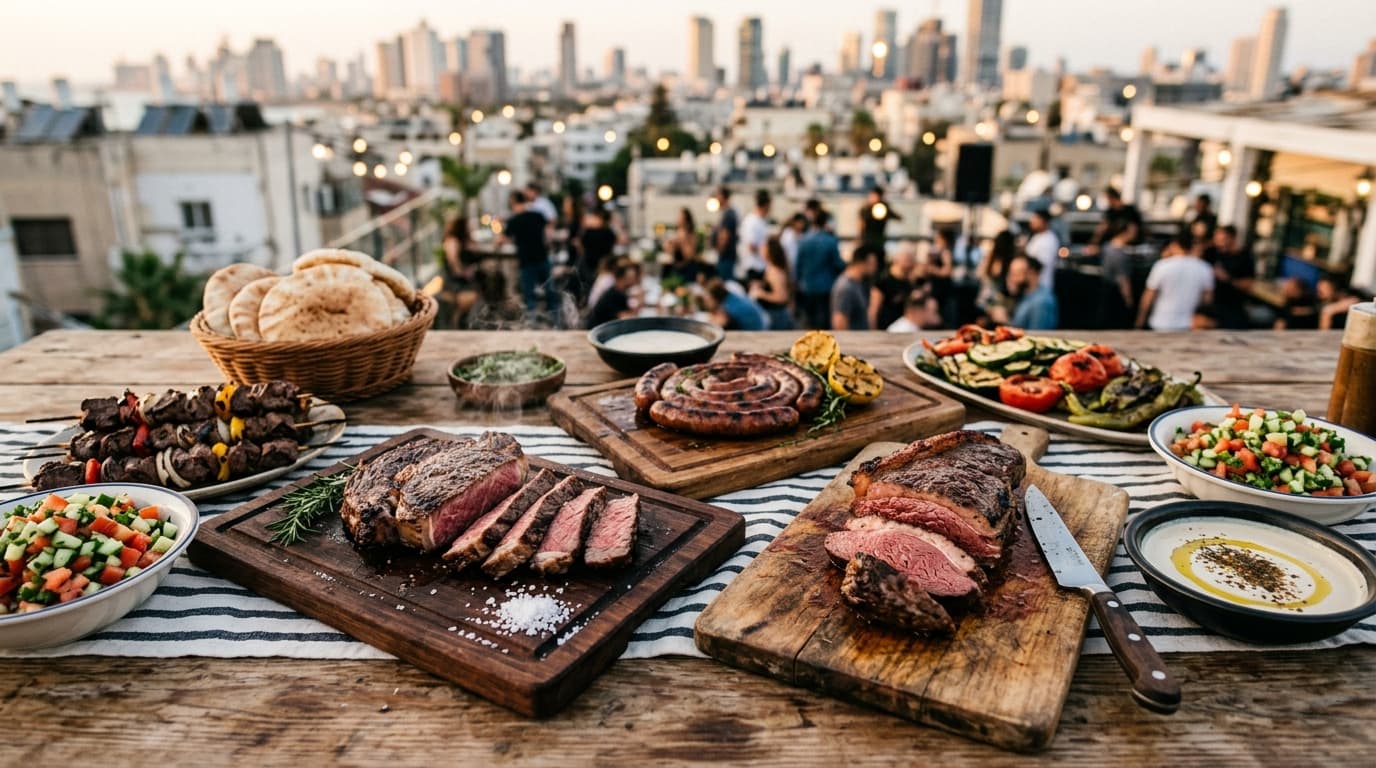
The mix that works is one or two premium cuts, sliced across the grain onto wooden boards as the centrepiece, carried by volume from the grill items. Kebab, pargit, merguez and arayes do the actual feeding — teenagers eat skewers, not dry-aged sirloin, and a nine-year-old will eat pargit and pita and nothing else and be perfectly happy. Put the tomahawk on the board for the photograph and the moment, and let the skewers carry the room.
Starters matter more here than at any other event we cook, because a family weekend has a forty-minute arrival curve and no host has ever planned for it. Beef carpaccio bruschetta, merguez with dijon and harissa, mini arayes, fire-roasted eggplant with tahini and pomegranate — on the table before the first steak comes off the grate. That is the single reason nobody stands at the grill asking how long, and at a family event the person who would otherwise ask is your uncle.
The cooking then runs in waves through the evening rather than as one service. Cuts come off, get sliced onto boards and go straight to where people are standing, then the next wave goes on. This suits a family crowd better than a seated service because people are moving between conversations anyway, and it means the food arrives hot at 21:00 and at 21:40 rather than all at once at 21:10 and lukewarm by 21:30.
What does it cost?
₪290 per guest, all-inclusive, from 20 guests, with a ₪6,700 event minimum that covers up to about 23 people. All-inclusive means the quote is the invoice: the cuts, starters, salads, breads and sauces, soft drinks, the grill and the coals, the crew — roughly one person per 15 to 20 guests — live cooking through the event, service and full cleanup. Loading premium cuts is the one thing that moves the per-guest number: two premium cuts takes it to ₪315, three or more to ₪340. A mehadrin setup with an arranged mashgiach is quoted on top as its own line.
For the small end — a weekday sheva brachot for one table, or the Thursday-night arrival before the crowd builds — the private chef format is the right shape rather than a shrunken event: ₪1,900 for two, ₪2,700 for four, ₪3,500 for six. Same fire, same butchers, sized for one table.
We cook on-site across Tel Aviv and the wider Gush Dan and up the coast through the Sharon, and the price does not change with the address — there is no travel line, no distance band and no out-of-city surcharge. The calculator on our homepage has no field for where you live, which is the easiest way to check that. A 50% deposit holds the date.
| Guests | Standard menu | With 3+ premium cuts |
|---|---|---|
| 2–6 (one table) | ₪1,900–₪3,500 | Private-chef format |
| 20–23 | ₪6,700 | ₪6,700 (minimum binds) |
| 30 | ₪8,700 | ₪9,000 |
| 40 | ₪11,600 | ₪12,000 |
| 50 | ₪14,500 | ₪15,000 |
| 60 | ₪17,400 | ₪18,000 |
| 80 | ₪23,200 | ₪24,000 |
When should you book, and what goes in the first message?
Earlier than you think, for a reason that has nothing to do with us. Weddings in Israel cluster, because large parts of the calendar are closed to them: most families do not hold weddings through the Sefirat HaOmer weeks until Lag BaOmer, or during the Three Weeks between 17 Tammuz and Tisha B'Av. Everything gets pushed into the windows that remain, and every one of those weddings drags a Shabbat chatan and a sheva brachot week behind it. A Saturday night in late June is competing against a lot of other Saturday nights in late June, for the same crews.
One WhatsApp message with five things: which meal of the weekend you want catered, the date, a rough guest count, the address, and a photo of the garden, yard, terrace or roof where the fire would stand. The photo answers the surface, the overhead clearance, the access and the size in one glance, which is why most setups get confirmed in that conversation instead of at a site visit three weeks later.
Two more lines that save a phone call: tell us whether the household keeps Shabbat, because that determines the whole motzei Shabbat timeline, and tell us the kosher standard by name if it matters to your guests. What comes back is a fixed quote naming the butcher and the certification, with the all-inclusive number for your guest count. And if the guest list is still moving — it is, both families are still arguing about it — send the date anyway. Guest counts can be adjusted up to a few days out. A Saturday night in wedding season cannot be conjured once it is taken.
Frequently asked
Can you cater a Shabbat chatan?
We can cater the parts of the weekend that are not Shabbat itself. Nobody can light a charcoal grill on Shabbat, so Friday night dinner, Shabbat lunch and seudah shlishit need a caterer whose food is built to be prepared in advance and held. What we cook is the Thursday-night arrival meal, a Friday-daytime meal eaten hot off the fire before candle-lighting, motzei Shabbat once Shabbat is out, and the weekday sheva brachot nights.
Which meal of a Shabbat chatan weekend should get the live fire?
Motzei Shabbat, if you want it inside the Shabbat itself — the family is already assembled and it is the first hot-off-the-fire food anyone has eaten since Thursday, after three meals of platters and cholent. But if you can move it, a weekday sheva brachot night between Sunday and Thursday is better still: no time constraint, normal setup, and typically 25 to 50 guests, which is exactly the range this format is built for.
Is Shabbat chatan before or after the wedding?
It depends on the community, and it is worth confirming before anyone books flights. In most Ashkenazi families it is the Shabbat before the wedding, when the groom is called to the Torah (the aufruf). In most Sephardi and Mizrahi families in Israel it is the Shabbat after the wedding, held inside the sheva brachot week.
How late does a motzei Shabbat event start?
Later than most hosts plan for. Our setup is about ninety minutes — assembling the grill, bringing charcoal to an even working heat, dressing tables and plating starters — and if the household keeps Shabbat the crew cannot set up during Shabbat, so that clock only starts when Shabbat ends. In a Tel Aviv July that is around 20:30, which puts first food at roughly 22:00. Pre-staging the equipment before Shabbat and only lighting afterwards cuts it to about fifty minutes; whether that works for your family is a question for your rav. Tell us whether the space is shomer Shabbat in the first message.
Can the meat be mehadrin?
On request, arranged per event. RBBQ is not a standing mehadrin kitchen with a permanent teudah — for a mehadrin event we source from Badatz-certified supply such as Atliz Lemhadrin in Kfar Shalem, which carries Badatz Machpud, Beit Yosef and Eda HaChareidis certification with an on-premise supervisor, arrange an on-site mashgiach, and dedicate the grill and utensils to the event. The mashgiach is quoted as its own line. Tell us the hechsher by name rather than the word 'kosher', because Eda HaChareidis, Machpud and Beit Yosef are not interchangeable for every family.
How much does Shabbat chatan or sheva brachot catering cost?
₪290 per guest all-inclusive from 20 guests, rising to ₪315 with two premium cuts and ₪340 with three or more, with a ₪6,700 event minimum covering up to about 23 guests. That covers meat from named butchers, starters, salads, breads and sauces, soft drinks, the grill and coals, the crew, live cooking, service and full cleanup. A 40-guest motzei Shabbat event on the standard menu is ₪11,600. Below 20 guests the private-chef format runs from ₪1,900 for two. A mehadrin setup with an arranged mashgiach is quoted on top.
What should the menu be for a four-generation family crowd?
One or two premium cuts sliced onto wooden boards as the centrepiece, with kebab, pargit, merguez and arayes carrying the volume — teenagers and children eat skewers, not dry-aged sirloin. Starters go out before the first steak leaves the grate to cover the forty-minute arrival curve: beef carpaccio bruschetta, merguez with dijon and harissa, mini arayes, fire-roasted eggplant with tahini and pomegranate. Everything is meat and grilled over one fire, so there is no dairy at the event; tell us the number of vegetarians rather than the fact that there are some.
How far in advance should we book?
As early as you can. Weddings in Israel cluster into the windows the calendar leaves open — most families avoid the Sefirat HaOmer weeks before Lag BaOmer and the Three Weeks between 17 Tammuz and Tisha B'Av — and every wedding pulls a Shabbat chatan and a sheva brachot week with it, so Saturday nights in season compete hard. A 50% deposit holds the date and the guest count can still move up to a few days before, so send the date before the list is final.