
Sukkot BBQ Catering: Live Fire Beside the Sukkah
TL;DR
Sukkot 2026 runs from sundown Friday, September 25 through Saturday night, October 3. On-site BBQ catering fits the chag better than any other holiday because the meal already belongs outdoors: the crew sets a charcoal grill in the garden, on the roof or on the balcony — always outside the sukkah, never under the s'chach — and cooks in waves while guests eat under the branches. For observant families the workable live-fire evenings are the five chol hamoed nights, Sunday September 27 through Thursday October 1, plus Friday-daytime cooks that finish before candle-lighting. From 20 guests it costs ₪290 per person all-inclusive (meat from named certified butchers, sides, drinks, crew, service, cleanup) with a ₪6,700 minimum covering up to about 23; a smaller sukkah table fits the private-chef format from ₪1,900. Those five chol hamoed nights are the whole supply for all of Gush Dan, so they book in August.
Can you actually run a live grill next to a sukkah?
Yes, and Sukkot is the one holiday where on-site cooking stops being a novelty and starts being the obvious format. Every other festive meal asks you to bring the outdoors in; Sukkot sends the whole table out. The food is meant to be eaten under s'chach, the evening air in early October is finally pleasant, and the guests are already outside — which is precisely the environment a live-fire crew is built for.
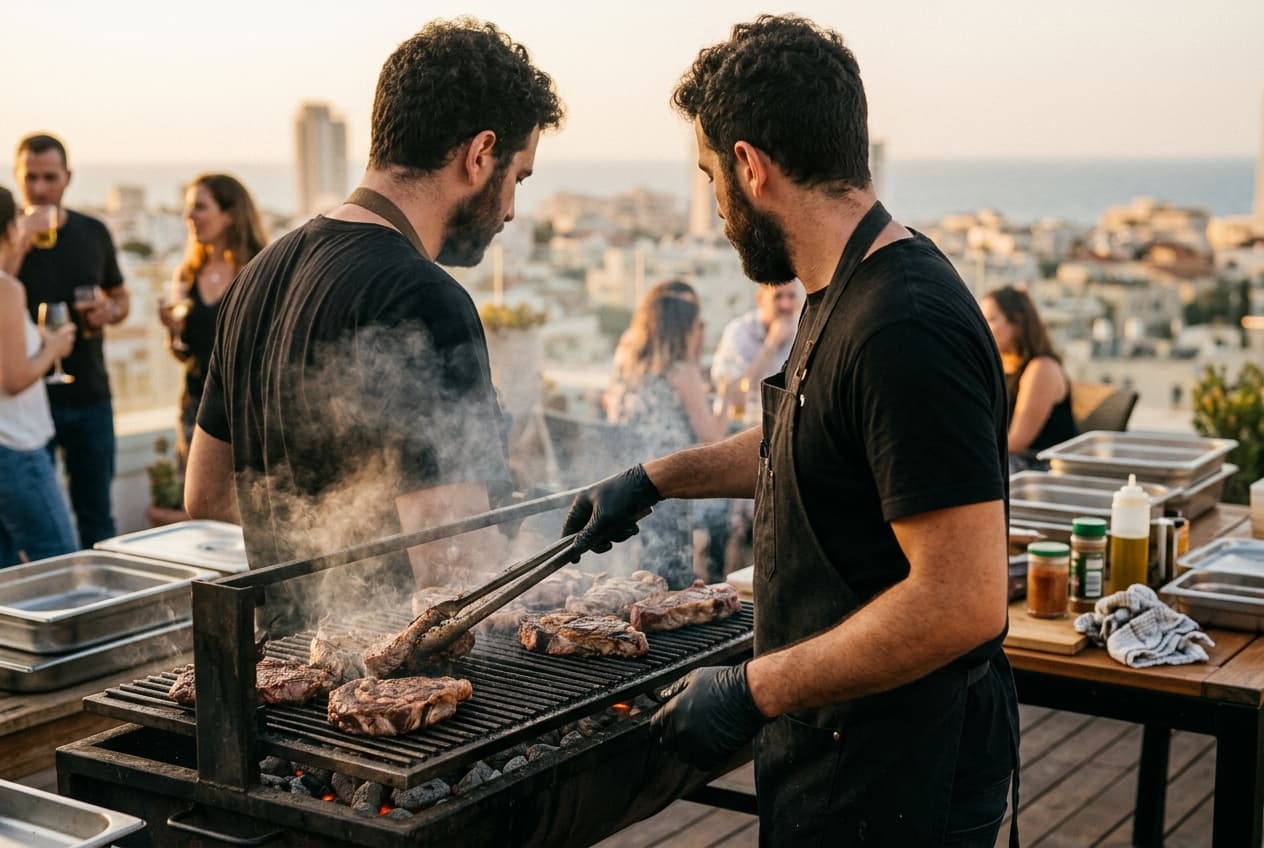
The one hard rule is placement: the grill goes outside the sukkah, never inside it and never under the s'chach. A sukkah roof is dry palm fronds or bamboo directly above head height, and a charcoal grill throws both radiant heat and the occasional spark. It also produces smoke that has nowhere to go once it hits a covered space, which turns a pleasant meal into a coughing one. In practice the crew sets up on the open side of the garden, on the terrace beside the sukkah, or on the far end of the roof, with a couple of metres of clear non-flammable ground around the coals and the prevailing breeze carrying smoke away from the seating. That distance is not a compromise, either. Guests still see and hear the fire, the food still arrives thirty seconds off the grate, and nobody is eating inside a smoke column.
The rest of the setup is the standard event: the crew arrives roughly 90 minutes early, builds the grill station, lays out starters, salads, breads and sauces, cooks premium cuts in waves through the meal, serves, and cleans everything down to the coals before leaving. If your sukkah is on a balcony or a shared roof, send a photo when you enquire. Some spaces genuinely cannot host live charcoal, and we would rather tell you that in July than discover it on the night.
When can the crew cook during Sukkot 2026?
The calendar first, because seasonal posts are where caterers get vague. Sukkot 5787 begins at sundown on Friday, September 25, 2026. The first day of the chag falls on Shabbat, September 26 — so the opening is one continuous Friday-evening-to-Saturday-night block, exactly as Rosh Hashana was two weeks earlier. Chol hamoed then runs Sunday, September 27 through Friday, October 2 (Hoshana Rabba), and the festival closes with Shemini Atzeret and Simchat Torah, kept as a single day in Israel, from Friday evening October 2 through Saturday night, October 3.
For a family that keeps the chag, that leaves five workable live-fire evenings: Sunday September 27 through Thursday October 1. Those are ordinary weekday nights on the calendar, in the middle of the week most Israelis have off, in the one week the sukkah is standing. They are the best dates of the entire Jewish year for this format, and there are five of them for the whole of Gush Dan. The two Fridays work differently: the crew cooks through the daytime and the food comes off the fire before candle-lighting, served hot that evening rather than delivered cold from across town. The two Shabbat-and-yom-tov blocks are simply out, and any caterer who tells you otherwise is selling you something.
If your family holds a stricter view about hired work during chol hamoed, say so when you book and we will build around it — a Friday-daytime cook, or a gathering the week before. For secular families, which is most of Tel Aviv in practice, the whole nine-day window is open, including the chag evenings themselves. Same crew, same food, different clock.
| Date | What it is | Live fire? |
|---|---|---|
| Fri Sep 25 (day) | Erev Sukkot | Yes — cook finishes before candle-lighting |
| Fri eve Sep 25 – Sat night Sep 26 | First day chag + Shabbat | No, for a family keeping the chag |
| Sun Sep 27 – Thu Oct 1 | Chol hamoed evenings | Yes — the five prime slots |
| Fri Oct 2 (day) | Hoshana Rabba | Yes — cook finishes before candle-lighting |
| Fri eve Oct 2 – Sat night Oct 3 | Shemini Atzeret / Simchat Torah | No, for a family keeping the chag |
What if the sukkah seats fewer people than you invited?
This is the practical problem nobody warns you about, and it is the reason Sukkot hosting goes wrong more often than Rosh Hashana hosting. A sukkah is sized by the space it stands in, not by your guest list. A typical Tel Aviv balcony sukkah seats somewhere between eight and sixteen people around a long narrow table. A garden sukkah in Ramat Gan or Herzliya might take twenty-five to forty. Then you invite the extended family, the neighbours drop in for ushpizin, and forty-five people are circling twenty chairs.
The live-fire format solves this better than a seated catered dinner does, because it is a standing event with a moving centre of gravity. The grill and the buffet sit outside on the open ground, guests come to the fire in waves, and the sukkah holds the core of the meal — kiddush, hamotzi, the people who need to be seated, the grandparents and the small children. Everyone else eats standing or in rotation around it, plate in hand, the way a good Israeli garden party works anyway. Nobody is counted against a seating chart, so a headcount that would break a formal dinner just spreads out.
Two things make that work in practice. Tell us the sukkah's seating capacity separately from the guest count when you enquire, because those are two different numbers and the setup is sized around the gap between them. And keep the path between the grill and the sukkah short and unobstructed — food off the fire should reach the table in under a minute, which means a clear route, not a staircase and two door frames.
| Sukkah | Typically seats | How the event runs |
|---|---|---|
| Balcony sukkah | 8–16 | Grill on the far end or terrace; seated meal inside, spillover standing |
| Rooftop sukkah | 15–30 | Grill upwind on open roof; buffet outside, sukkah seats the core |
| Garden sukkah | 25–40 | Grill station on the lawn or patio; full outdoor buffet |
| Guests exceed seats | Any | Standing buffet outside, sukkah for kiddush, hamotzi and seated guests |
What does a Sukkot BBQ event cost?
From 20 guests, ₪290 per person, all-inclusive, with a ₪6,700 event minimum. All-inclusive means the quote is the invoice: premium cuts bought by name from certified butchers, starters, salads, breads and sauces, soft drinks, the grill and the coals, the crew, live cooking through the meal, service, and full cleanup. There is no setup fee, no staffing line and no chag surcharge — a chol hamoed Tuesday is priced like any other Tuesday.
The ₪6,700 minimum binds up to about 23 guests, so a 20-person sukkah dinner pays the minimum rather than a smaller number, and from roughly 24 people the per-head price simply multiplies out: 30 guests is ₪8,700, 40 is ₪11,600, 50 is ₪14,500. Split across the households arriving for the week, it usually lands under what each family would spend on one restaurant meal.
Below 20 guests the event format does not run, and pushing you into it would be selling you the wrong product. A small sukkah table — parents, a couple of siblings, a few grandchildren — fits the private-chef format instead: ₪1,900 for two, ₪2,700 for four, ₪3,500 for six, same fire and same sourcing, sized for one table under the s'chach. You can price your own headcount in the calculator on our homepage before you send a single message.
| Guests | Price | How it's calculated |
|---|---|---|
| 2–6 (one sukkah table) | ₪1,900–₪3,500 | Private-chef format, published ladder |
| 20–23 | ₪6,700 | Event minimum applies |
| 30 | ₪8,700 | 30 × ₪290 |
| 40 | ₪11,600 | 40 × ₪290 |
| 50 | ₪14,500 | 50 × ₪290 |
How does kosher sourcing work, and when should you book?
A family that builds a sukkah usually cares where the meat came from, so sourcing is the part worth interrogating — with us or with anyone else. Our cuts are bought by name from certified butchers and the butcher is written onto your quote: Bat HaKatzav in Ramat Aviv, a long-standing family butcher shop in north Tel Aviv; Meshek Lagziel in Ramat Gan, a sixty-year family business founded by David Lagziel and known for dry-aged beef and its house kebab; and for a stricter standard, Atliz Lemhadrin in Kfar Shalem, which carries Badatz Machpud, Beit Yosef and Eda HaChareidis certification. For events that need supervision and not only sourcing, an on-site mashgiach and a dedicated kashered grill can be arranged per event, on request — arranged for your date, not a standing kitchen certificate, which is the honest way to put it. Name the standard your family holds when you book, get the certification in writing, and check it against the Chief Rabbinate's public kosher databases, which exist precisely so no host has to take a caterer's word for anything.
On timing: this is the tightest booking window of the year and the arithmetic is unforgiving. There are five chol hamoed evenings, one erev-chag Friday and one Hoshana Rabba Friday, and every family gathering, sheva brachot and company event in Gush Dan is competing for them — in a month that already lost its second weekend to Rosh Hashana (September 11 to 13) and a Monday to Yom Kippur (September 21). September and early-October dates are, in practice, August bookings.
Booking is one message: guest count, the date you want, the sukkah's seating capacity, and a photo of the garden, roof or balcony where the fire would sit. Read how a live-fire event actually runs on our about page, look at the private-chef page if the table is small, and send the details on WhatsApp for a fixed quote with the butcher named on it. If the space cannot safely host charcoal beside a sukkah, we will say so before you commit to anything, including to us.
Frequently asked
Can you barbecue during Sukkot?
Yes, on the chol hamoed weekdays — in 2026 that is Sunday September 27 through Thursday October 1, plus Friday-daytime cooks on September 25 and October 2 that finish before candle-lighting. For a family keeping the chag, the two Shabbat-and-yom-tov blocks (Friday evening September 25 to Saturday night September 26, and Friday evening October 2 to Saturday night October 3) are out. Secular families often hold the live-fire meal on the chag evenings themselves; that is the family's call.
Can the grill go inside the sukkah?
No. A charcoal grill never goes under the s'chach — dry palm or bamboo covering directly above a live fire is a hazard, and the smoke has nowhere to escape from a covered space. The crew sets up outside the sukkah on open ground with a few metres of clearance, positioned so the breeze carries smoke away from the seating, and the food still reaches the table under a minute off the grate.
What if we invited more people than the sukkah seats?
That is the normal case, and it is why a live-fire buffet suits Sukkot better than a seated catered dinner. The grill and buffet sit outside, the sukkah holds the core of the meal and the guests who need to be seated, and everyone else eats standing or in rotation. Tell us the sukkah's seating capacity and the guest count as two separate numbers, and the setup is sized around the gap.
How much does Sukkot BBQ catering cost?
₪290 per guest all-inclusive from 20 people — meat from named certified butchers, sides, drinks, crew, live cooking, service and cleanup — with a ₪6,700 minimum covering up to about 23 guests. There is no holiday surcharge. A smaller sukkah table fits the private-chef format: ₪1,900 for two, ₪2,700 for four, ₪3,500 for six.
When is Sukkot 2026 and when should we book?
Sukkot 5787 runs from sundown Friday, September 25 through Saturday night, October 3, 2026, with chol hamoed from Sunday September 27. Because the whole festival offers only five workable evenings for a live-fire crew and September also loses dates to Rosh Hashana and Yom Kippur, Sukkot dates are effectively booked in August.