
Private Chef Cost Per Month vs Per Event: The Honest Math
TL;DR
There is no honest single answer to what a private chef costs per month, because the question covers two unrelated jobs. A household chef who cooks on a recurring schedule is an employment arrangement, priced as a salary plus employer costs or as a freelance per-visit rate, and RBBQ does not sell it. A private fire chef is priced per evening: ₪1,900 for two, ₪2,700 for four, ₪3,500 for six, and ₪400 for each guest beyond that, up to about ten, with 18% VAT already inside and no service charge or tip. Converting that into a month is simple arithmetic and nothing more, because there is no subscription and no volume discount: a table of four once a month is ₪2,700, twice a month ₪5,400, and every Friday ₪10,800. Cost per evening does not fall with frequency, because each evening carries its own shopping, transport, setup, cooking and cleanup. It falls with guest count. A private-chef evening for six works out at ₪583 a head, while event catering from 20 guests is ₪290 a head all-inclusive, with a ₪6,700 event minimum. If a recurring number is what worries you, the lever is how many people are at the table, not how many times a year you host.
How much does a permanent private chef cost per month?
The search behind this question is real and the honest answer is that it hides two different jobs. The first is a household chef: someone who cooks for your family on a schedule, plans meals, does the shopping and works in your kitchen on a weekday. That is an employment arrangement rather than a booking, and it is priced either as a salary with the employer costs that sit on top of any Israeli salary — pension contributions, severance provision, national insurance, paid holiday and sick days — or as a freelance rate per visit. Anyone who quotes you a flat monthly figure without first saying which of those two structures they mean has not given you a price. They have given you a guess.
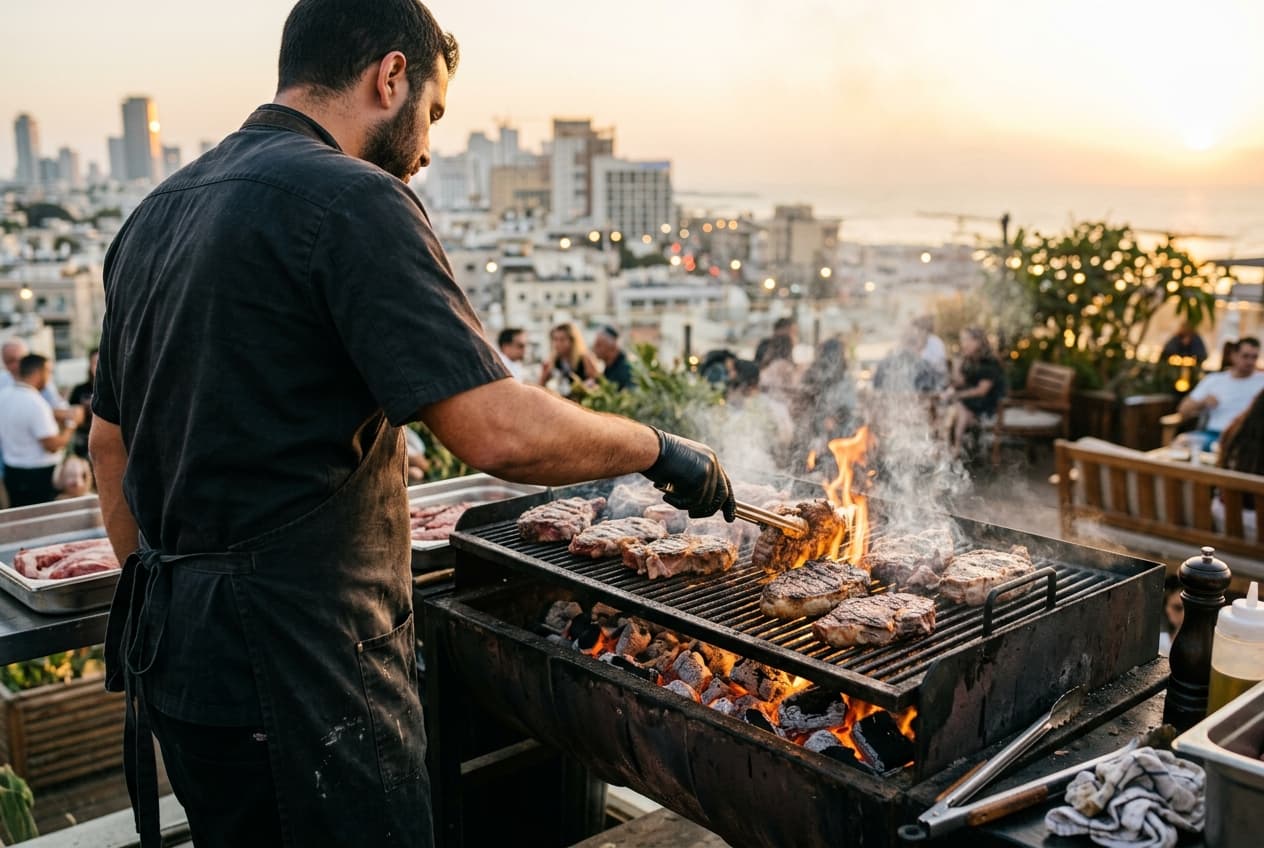
The second job is a private fire chef for an occasion: one chef, one fire, premium cuts cooked in front of the table and served in waves, on your balcony, roof or garden. That is what RBBQ does, and it is priced per evening rather than per month. ₪1,900 for two, ₪2,700 for four, ₪3,500 for six, and ₪400 for each guest beyond that up to about ten. Every one of those figures includes 18% VAT, and there is no service charge and no expected tip on a chef you hired directly. Nothing is rented separately and there is no setup fee.
We do not sell a retainer, a subscription or a package of dates at a discount, and it is fairer to say that plainly than to invent one. So the monthly number is arithmetic you can do yourself, which is exactly why the table below exists.
Read the right-hand column before the left one. A household that hosts properly six times a year at a table of six spends ₪21,000 across the year, which averages to ₪1,750 a month. That is the number most people are actually asking about when they type the question, and it looks nothing like the weekly figure.
| Cadence | Table of two | Table of four | Table of six |
|---|---|---|---|
| Every Friday (4 evenings) | ₪7,600 | ₪10,800 | ₪14,000 |
| Twice a month | ₪3,800 | ₪5,400 | ₪7,000 |
| Once a month | ₪1,900 | ₪2,700 | ₪3,500 |
| Six times a year, averaged | ₪950/mo | ₪1,350/mo | ₪1,750/mo |
Why does the price per evening never fall if I book more often?
Because almost none of the cost is the cooking. An evening carries a menu built with you in advance, a butcher run for cuts bought that week rather than pulled from a freezer, the drive and the loading, roughly 60 to 90 minutes of setup before anyone eats, the charcoal, the fire held at temperature across several courses, service through the evening, and a cleanup that leaves the space as it was. Booking that same evening four times in a month does not make any one of those steps shorter. It just means we do them four times.
This is where a genuine retainer differs, and it is worth understanding rather than dismissing. A household chef employed on a schedule really does get cheaper per meal, because the shopping is consolidated, the kitchen is already theirs, the equipment stays put, there is no setup and no breakdown, and a weekday dinner is not a multi-course occasion. That efficiency is real. It is simply not available to a chef who brings a fire and a full mise en place to a different address each time.
So if someone offers you a live-fire chef on a discounted monthly subscription, ask which of those steps they intend to skip. In practice the answer is the sourcing: cheaper cuts, or meat bought in bulk and frozen ahead. That is a legitimate business, but it is a different product from the one you thought you were pricing.
What actually lowers the cost per person?
Guest count, decisively. The private-chef format is priced per evening, so the more people sit at the table, the less each of them costs. Two guests at ₪1,900 is ₪950 a head. Four at ₪2,700 is ₪675. Six at ₪3,500 is ₪583. That curve keeps bending in your favour right up to about ten guests, which is where one chef on one fire runs out of hands.
Past that, the format changes and the per-head number drops again, hard. Event catering starts at 20 guests and runs at ₪290 per guest all-inclusive, ₪315 if the menu carries two premium cuts and ₪340 with three or more, against a ₪6,700 event minimum that binds up to about 23 people. A 30-guest party is ₪8,700 and a 40-guest one is ₪11,600. Children are billed at 55% of a portion, applied to the food rather than to the consumables.
Put those side by side and the shape of the decision is clear. One evening for six costs ₪583 a head. One evening for thirty costs ₪290 a head. Doing the six-guest dinner twice as often costs twice as much; inviting more people to one of them costs less per person than doing it at all.
The honest gap sits between ten and twenty guests, and any caterer who answers smoothly there is guessing. It is too many for one chef on a single fire and still below the event minimum, so a 14-guest dinner pays the same ₪6,700 floor as a 23-guest one. That floor is not aimed at you. The van, the crew call, the setup and the cleanup cost nearly the same whether the guest list is 14 or 23.
| Guests | Format | Total | Per head |
|---|---|---|---|
| 2 | Private fire chef | ₪1,900 | ₪950 |
| 4 | Private fire chef | ₪2,700 | ₪675 |
| 6 | Private fire chef | ₪3,500 | ₪583 |
| 14 | Below the minimum | ₪6,700 | ₪479 |
| 23 | Event catering (minimum binds) | ₪6,700 | ₪291 |
| 30 | Event catering | ₪8,700 | ₪290 |
| 40 | Event catering | ₪11,600 | ₪290 |
Which recurring pattern is real for an Israeli household?
Weekly is almost never it. The rhythm that actually repeats here is the calendar: Friday night when the family is already coming, the Tishrei run of Rosh Hashana and Sukkot, a birthday that lands in the same month every year, a Pesach-adjacent gathering, an engagement or a Shabbat chatan. That is four to eight occasions a year for a household that hosts seriously, and each of them is a separate booking at the published price.
Treating it that way costs you nothing and buys you something a subscription would not. Because there is no retainer, there is also no dead month: you do not pay in February for a fire you did not light. And because the price is fixed per evening rather than negotiated per relationship, the number you were quoted in March is the number in October.
What booking ahead does buy is the date itself. Thursday evenings, Friday afternoons, the Tishrei window in September and October, the run-up to Pesach and Yom Ha'atzmaut all fill first, and a late request into one of those windows is often a genuine no rather than a negotiation. If you know you host every Rosh Hashana, say so in August. A 50% deposit is what holds a date; the final headcount can still move until a few days before.
There is one recurring arrangement we do run, and it is worth naming so the picture is complete: companies that book us several times across a year for offsites, holiday evenings and team dinners. That is still per-event pricing on each date, with no retainer and no annual commitment. What changes is only that the calendar conversation happens once instead of four times.
What are you actually hiring, and what comes off the fire?
Premium cuts cooked to temperature over charcoal, plus everything around them. Entrecôte, picanha, tomahawk, sirloin, Denver and flat iron on the steak side; pargit, kebab, merguez, wings, arayes and skewers on the grill side. Starters, salads, breads, house sauces and hot sides come off the same fire. Guests who do not eat meat are a menu input rather than an emergency: named guests eat salmon, sea bass or denis instead of meat and are counted that way, as a substitution rather than an extra course.
The meat is bought from named butchers rather than an anonymous supplier, and the name goes on your quote: Bat HaKatzav on Brodetzky 43 in Ramat Aviv, Meshek Lagziel and Roni Tassa's boutique butchery in Ramat Gan, and for mehadrin requests Atliz Lemhadrin on Tzora 3 in Kfar Shalem, which carries Badatz Machpud, Beit Yosef and Eda HaChareidis certification. Kosher is available on request rather than a standing certification we claim, and a mehadrin evening means an on-site mashgiach and a kashered grill, arranged per event and quoted as its own line rather than buried inside the per-guest number. Whichever standard you need, the butcher and its certifying body belong in writing on the quote, and you can check that shop yourself against the Chief Rabbinate's public kosher business database before paying a deposit.
The requirement for the space is ventilation rather than size. Charcoal produces smoke and carbon monoxide, so the grill stands somewhere genuinely open: a balcony that is open rather than glassed in, a roof terrace, a courtyard, a garden. There is no indoor version of this. If the roof is shared it belongs to the va'ad bayit, so ask before you fix a date, and in a dense Tel Aviv building a weeknight evening should be winding down around 23:00.
We cover Tel Aviv, Gush Dan and the Sharon with no travel surcharge, which is why the calculator on the homepage has no field for your address. Booking runs on WhatsApp, the quote is a written message with numbers in it rather than a designed PDF, and a photograph of the balcony, roof or garden answers more than a paragraph of description.
Frequently asked
How much does a private chef cost per month in Israel?
It depends which job you mean. A household chef on a recurring schedule is an employment arrangement priced as a salary plus employer costs, or as a freelance rate per visit, and RBBQ does not offer it. A private fire chef is priced per evening: ₪1,900 for two, ₪2,700 for four, ₪3,500 for six, ₪400 per additional guest up to about ten. Once a month at a table of four is ₪2,700; every Friday is ₪10,800. All figures include 18% VAT.
Do you offer a monthly subscription or a retainer?
No. There is no subscription, no retainer and no discounted package of dates. Every evening is booked and priced on its own, at the published price. The upside is that there is no month where you pay for a fire you did not light, and the quote you were given in March is the same number in October.
Is it cheaper if I book several dates at once?
No, and it would be dishonest to pretend otherwise. Each evening carries its own butcher run, drive, 60 to 90 minutes of setup, charcoal, service and cleanup, so booking four evenings costs four times one evening. What booking ahead does buy is the date itself, which matters in the Tishrei window, around Pesach and on Yom Ha'atzmaut.
What makes the price per person go down?
Guest count, not frequency. Two guests works out at ₪950 a head, four at ₪675 and six at ₪583. From 20 guests it becomes event catering at ₪290 a head all-inclusive, so a 30-guest evening is ₪8,700. Inviting more people to one evening lowers the cost per person; repeating a small evening does not.
Would a household chef really be cheaper than booking you every week?
For genuinely weekly weekday cooking, yes, and we would tell you so. An employed household chef consolidates the shopping, works in a kitchen that is already set up, and does not rebuild a fire and a full mise en place at a new address each time. Those savings are real and they are not available to a live-fire chef. We are the right call for occasions, not for Tuesday dinner.
Is there a minimum, and where does event catering start?
The private-chef format has no minimum and starts at two guests. Event catering starts at 20 guests, with a ₪6,700 event minimum that binds up to about 23 people, so a 14-guest dinner pays the same floor as a 23-guest one. Between roughly ten and twenty guests there is a genuine gap in the format, and we would rather name it than talk around it.
Do the prices change outside Tel Aviv?
No. We cover Tel Aviv, Gush Dan and the Sharon with no travel surcharge, which is why the calculator has no address field. Beyond that ring the answer is a calendar question rather than a price one, and it is answered per date.
What do you need from me to quote an evening?
The date, how many guests and how many of them are children, the address or at least the neighbourhood, what kind of space it is, whether it needs to be kosher and at what standard, and any allergies or guests who do not eat meat. If you already know you host every Rosh Hashana or every Friday in the summer, say that too and we will hold the dates rather than sell you a package.