Rosh Hashana BBQ Catering: Which Meal a Live Fire Can Actually Cook
TL;DR
Rosh Hashana 2026 begins at sundown on Friday, September 11 and runs through nightfall on Sunday, September 13, straight through Shabbat with no break in between. No live fire runs during that block. What a crew can cook is the meal before it starts, or the meal once it ends: for gatherings of 20 or more, ₪290 per guest all-inclusive, meat from named certified butchers, sides, drinks, crew, service and cleanup.
Why cook the Rosh Hashana feast over fire instead of three days in the kitchen?
Rosh Hashana is the one table almost every Israeli family sets, whatever else they do or don't keep: three generations, siblings with their kids, the aunt who grades everyone's food. It is also, for whoever hosts, a cooking marathon — shopping on Wednesday, pots going from Thursday, and a host who spends the actual dinner ferrying dishes instead of sitting down. In 2026 the holiday runs Friday evening through Sunday night, which means back-to-back festive meals and a hosting load that normally swallows the whole weekend.
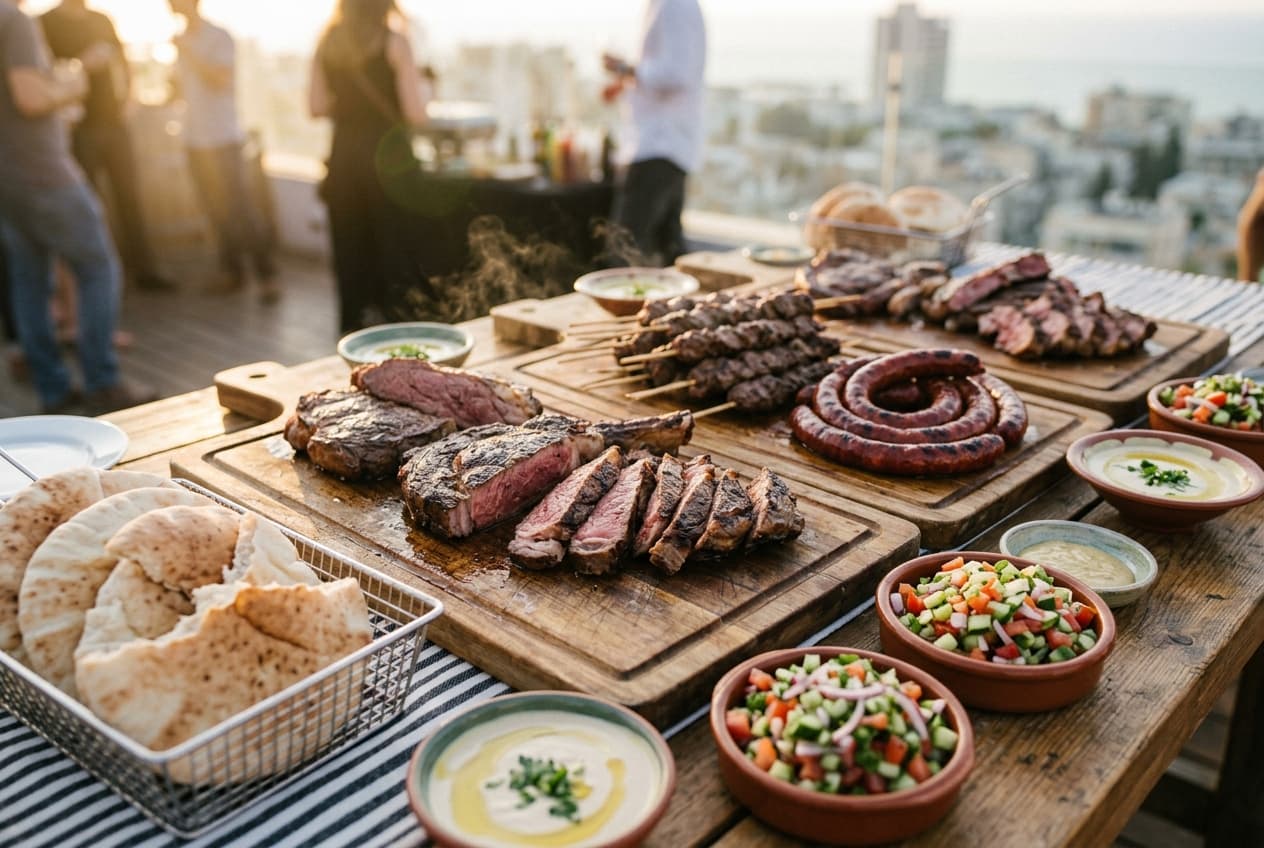
For the meals a crew can actually cook, erev chag or motzaei chag, the arrangement flips. The team arrives about 90 minutes beforehand, sets up a charcoal grill in the garden, on the balcony or on the roof, and cooks premium cuts in waves while the family does the thing the holiday is actually for. Starters, salads, breads and sauces come with them, and so does the serving gear.
And the food itself argues for it. The centerpiece of a festive meat meal — entrecote, picanha, lamb, kebabs off the fire — is exactly the food that suffers most from being cooked a day ahead and reheated. Off the grill and straight to the table, the holiday main course is simply a better dish than anything that waited in an oven since yesterday.
When can a live-fire crew actually cook, given the 2026 dates?
Honesty first, because this is where a seasonal post can mislead: Rosh Hashana 2026 begins at sundown on Friday, September 11 and ends at nightfall on Sunday, September 13 — a continuous Shabbat-plus-chag block. A catering crew does not work a live fire during that block for a family that keeps the holiday, and anyone who implies otherwise is selling you something.
For observant families the format still works — it just moves to the edges. The classic slot is Friday daytime, September 11: the crew cooks through the early afternoon, the food comes off the fire shortly before candle-lighting, and the meal is served that evening after shul, hot from the warming setup rather than from a delivery box that left a kitchen across town at noon. The other pattern we see every year is the big extended-family gathering held on a weekday around the holiday — the Thursday before, or one of the days between Rosh Hashana and Yom Kippur — where the live fire runs exactly as it would at any event.
For secular families — most of Tel Aviv, in practice — the erev-chag dinner itself is the natural fit: the crew grills through Friday evening while the family eats, toasts and argues about politics, and the fire is part of the evening rather than a constraint on it. Both versions are the same product with the same crew; the only difference is the clock, so say which family you are when you book and the schedule is built around it.
What does the holiday feast cost?
For a family gathering of 20 or more, the price is ₪290 per guest, all-inclusive, with a ₪6,700 event minimum. All-inclusive means the number on the quote is the number you pay: premium cuts bought by name from certified butchers, starters, salads, breads and sauces, soft drinks, the grill and coals, the crew, live cooking through the meal, service and full cleanup. No setup fee, no staffing line, no surprise on the invoice the week after the chag.
The ₪6,700 minimum binds up to about 23 guests — a 20-person family table pays the minimum, not a smaller number, and from around 24 guests the per-head price multiplies out. A typical three-generation gathering of 30 lands at ₪8,700; the full-clan version at 50 comes to ₪14,500. Divide by the number of households chipping in and it usually costs each family less than hosting a single restaurant dinner.
Below 20 guests the event format does not run, and pretending otherwise would price you into the wrong product. A smaller holiday table — parents, two couples, a handful of grandchildren — fits the private-chef format instead: the published ladder starts at ₪1,900 for two, ₪2,700 for four and ₪3,500 for six, same fire and same sourcing, sized for a single table. Between those two formats, every realistic Rosh Hashana headcount has a price you can check before you ever send a message.
| Family gathering | Price | How it's calculated |
|---|---|---|
| 2–6 (small table) | ₪1,900–₪3,500 | Private-chef format, published ladder |
| 20–23 | ₪6,700 | Event minimum applies |
| 30 | ₪8,700 | 30 × ₪290 |
| 40 | ₪11,600 | 40 × ₪290 |
| 50 | ₪14,500 | 50 × ₪290 |
How does the kosher side work for the holiday table?
At a Rosh Hashana table the question is not abstract — someone at that table keeps kosher, and the food has to work for them or the gathering splits. So the sourcing is the part to interrogate, with us or with any caterer. Our cuts are bought by name from certified butchers and the butcher goes on your quote in writing: Bat HaKatzav in Ramat Aviv, a family butcher shop with more than fifty years of lineage; Meshek Lagziel in Ramat Gan, a sixty-year family business known for dry-aged beef and its house kebab; and when the family wants a stricter standard, Atliz Lemhadrin in Kfar Shalem, which carries Badatz Machpud, Beit Yosef and Eda HaChareidis certification.
For tables that need supervision and not just sourcing, a mashgiach on-site and a dedicated kashered grill can be arranged per event, on request. That is the honest framing — it is arranged for your date, not a standing kitchen certificate — so name the standard your family holds when you book, and verify the paperwork in writing. The Chief Rabbinate's public kosher databases exist exactly so that no host has to take a caterer's word for anything the week before the chag.
The seasonal touches travel well on this format too. Apples and honey, the simanim, grandmother's non-negotiable side dish — the grill takes over the mains and the spread around it stays yours. Tell the crew in advance what the family table must include, along with the vegetarian count, and the setup is sized around it.
When should you book — and what does Tishrei do to September?
September 2026 is a compressed month. Rosh Hashana takes the September 11–13 weekend, Yom Kippur lands on September 21, and Sukkot begins on the evening of September 25 — which leaves a handful of workable weekdays that every family event, sheva brachot and company gathering in Gush Dan is competing for. The Friday-daytime slots before the chag are the scarcest of all, because there is exactly one erev Rosh Hashana.
The practical rule: a September date is an August booking. By the first week of September the pre-chag slots are gone, and what remains is the mid-week gaps between the holidays — which are genuinely good dates, often cooler in the evening and easier for out-of-town family than the chag itself, but only if you take one before they go too.
Booking takes one message: headcount, date, and a photo of the garden, balcony or roof where the fire would sit. You can price your own headcount in the calculator on our homepage, read how a live-fire event actually runs on our about page, and send the details on WhatsApp for a fixed quote with the butcher named on it. If the space cannot host coals, we will say so before you commit to anything — including to us.
Frequently asked
How much does Rosh Hashana BBQ catering cost in Israel?
At RBBQ, ₪290 per guest all-inclusive for gatherings of 20 or more — premium meat from named certified butchers, sides, drinks, crew, live cooking, service and cleanup — with a ₪6,700 minimum covering up to about 23 guests. A smaller holiday table fits the private-chef format: ₪1,900 for two, ₪2,700 for four, ₪3,500 for six.
Can a BBQ crew cook during Rosh Hashana itself?
Not for a family that keeps the chag — Rosh Hashana 2026 runs from Friday evening September 11 through Sunday night September 13, and no crew works a live fire during that block for an observant household. The honest options are a Friday-daytime cook finishing before candle-lighting, or a family gathering on a weekday around the holiday. Secular families often hold the live-fire dinner on the chag evening itself; that is the family's call.
Does it work for a kosher-observant family?
The meat is bought by name from certified butchers — Bat HaKatzav in Ramat Aviv, Meshek Lagziel in Ramat Gan, or Atliz Lemhadrin in Kfar Shalem (Badatz Machpud, Beit Yosef, Eda HaChareidis) for a stricter standard — and the butcher is named on the quote. A mashgiach and a dedicated kashered grill can be arranged per event on request. State your family's standard when booking and verify certification in writing.
When is Rosh Hashana 2026 and when should we book?
Sundown Friday, September 11 through nightfall Sunday, September 13, 2026. Because Yom Kippur (September 21) and Sukkot (from September 25) compress the rest of the month, September dates effectively book in August — and the erev-chag Friday slots go first.
What if the family is fewer than 20 people?
The event format has a 20-guest floor and a ₪6,700 minimum. A smaller holiday table fits the private-chef format instead — same fire, same named-butcher sourcing, published prices from ₪1,900 for two up to ₪3,500 for six, sized for a single table.